The Importance of Safe and Clean Drinking Water in Long Island City
Access to safe drinking water is a fundamental right in Long Island City. The quality of our water directly affects our health and well-being. Water contamination from industrial activities, wastewater runoff, and outdated infrastructure can introduce harmful substances. These pose serious health risks.
Significant investments have been made in water treatment and water infrastructure in New York. Over $5.5 billion has been allocated for clean water infrastructure, with $700 million for Long Island. These funds support critical projects, like the State Septic System replacement program, which has received $66.1 million.
Local efforts, such as the Suffolk County Water Quality Restoration Act, also play a role. This act aims to address nitrogen pollution, threatening ground and surface waters. It’s expected to create thousands of jobs in sewer infrastructure buildout.
Long Island City’s drinking water meets strict federal standards, including for PFAS, or “forever chemicals.” Regular testing keeps PFAS levels below detectable limits. The U.S. Environmental Protection Agency (EPA) has set a near-zero standard for PFAS in drinking water.
Despite these efforts, challenges remain. Saltwater intrusion is a risk in parts of Long Island’s drinking water supply. This issue is caused by over-pumping of groundwater, rising sea levels, and urban development. It may take generations to reverse.
Addressing saltwater intrusion requires sustainable water management and advanced treatment technologies like reverse osmosis. By focusing on water infrastructure, water treatment, and source protection, Long Island City aims to provide safe drinking water. Collaboration between state and local agencies, along with public awareness and participation, is key to safeguarding this vital resource for future generations.
Overview of New York State and National Drinking Water Regulations
New York State is committed to protecting public health by reducing exposure to harmful chemicals in drinking water. It works closely with the Environmental Protection Agency (EPA) and local health departments. This ensures all public water systems in New York meet strict drinking water standards. By aligning its rules with federal ones, New York State aims to offer consistent protection to its residents.

New York State’s Commitment to Reducing Exposure to Chemicals in Drinking Water
To tackle the growing concern over emerging contaminants like Per- and Polyfluoroalkyl Substances (PFAS), the EPA is setting Maximum Contaminant Levels (MCLs) for six PFAS compounds. These include:
| Compound | MCL (ng/L or ppt) |
|---|---|
| Perfluorooctanoic acid (PFOA) | 4.0 |
| Perfluorooctane sulfonic acid (PFOS) | 4.0 |
| Perfluorohexane sulfonic acid (PFHxS) | 10 |
| Perfluorononanoic acid (PFNA) | 10 |
| Hexafluoropropylene oxide dimer acid (HFPO-DA) | 10 |
Also, a Hazard Index Maximum Contaminant Level (MCL) of 1 is set for mixtures of PFHxS, PFNA, HFPO-DA, and perfluorobutane sulfonic acid (PFBS).
Collaboration with the Environmental Protection Agency (EPA) and Local Health Departments
New York State works closely with the EPA and local health departments to enforce environmental regulations and protect drinking water quality. Public water systems must conduct regular monitoring and testing to meet federal and state standards. The EPA predicts that the new PFAS regulations will prevent 29,858 illnesses and 9,614 deaths in communities by reducing PFAS levels in drinking water.
The Bipartisan Infrastructure Law (BIL) provides over $11.7 billion for the Drinking Water State Revolving Fund (DWSRF) General Supplemental. An additional $4 billion is allocated for addressing emerging contaminants. Also, $5 billion in grants is designated for small or disadvantaged communities facing emerging contaminants in their drinking water.
Long Island City’s Compliance with Federal and State Water Quality Standards
Long Island City is dedicated to the safety and dependability of its drinking water. It follows strict federal and state water quality standards. The city’s public water systems work hard to stay compliant. They do this through regular monitoring and water testing. This ensures the water meets or exceeds all regulatory standards. In addition to rigorous monitoring, Long Island City frequently publishes its water quality reports, allowing residents to stay informed about the safety of their drinking water. These reports include the long island city water testing results, which provide transparency and build trust within the community. The city encourages residents to review these findings to understand the quality of their water and to feel confident in its safety.
Long Island City’s water systems monitor over 100 contaminants, including PFOA, PFOS, and 1,4-dioxane. This thorough water testing helps spot issues early. It allows for quick action to keep water quality and reliability at the highest levels.
Regular Monitoring and Testing of Drinking Water
Long Island City’s public water systems do extensive sampling and analysis. They ensure compliance with all applicable standards. This includes:
- Routine sampling at various points throughout the distribution system
- Testing for a wide range of chemical, physical, and microbiological parameters
- Monitoring for unregulated contaminants to identify emerging threats
- Reporting all detected levels of PFOA, PFOS, and other PFAS compounds
By consistently monitoring and testing, Long Island City can quickly find and fix any problems. This ensures the water remains safe and reliable for consumers.
Ensuring Safety and Reliability of Water Supply
Long Island City’s water systems also use various strategies to keep the water safe and reliable. These include:
- Implementing advanced treatment technologies to remove contaminants
- Investing in infrastructure upgrades to maintain the integrity of the distribution system
- Collaborating with local, state, and federal agencies to address water quality concerns
- Providing transparent communication to the public about water quality and compliance
Through these efforts, Long Island City shows its strong commitment to delivering safe, clean, and reliable drinking water. It does this in full compliance with all federal and state water quality standards.
Understanding PFAS and Their Impact on Drinking Water Quality
Per- and polyfluoroalkyl substances (PFAS) are man-made chemicals introduced in the 1940s. They repel water and oil, resist heat, and chemical reactions. Yet, their widespread use raises health and environmental concerns, mainly about drinking water contaminants.
In New York State, about 50% of public water systems show PFAS contamination. Around 250 systems exceed state standards for PFOA and PFOS. This is alarming, as 2 million New Yorkers on private wells may unknowingly consume contaminated water.
What are Per- and Polyfluoroalkyl Substances (PFAS)?
PFAS include thousands of synthetic chemicals, with PFOA and PFOS being the most recognized. Their carbon-fluorine bonds make them highly stable and resistant to breakdown. This has earned them the nickname “forever chemicals.”
These substances are found in various products, such as:
- Non-stick cookware
- Water-repellent clothing and fabrics
- Stain-resistant carpets and upholstery
- Food packaging materials
- Firefighting foams
Health Risks Associated with PFAS Exposure
The NRDC reports that 98% of Americans have PFAS in their blood. Exposure to certain PFAS can lead to serious health effects. These include:
- Increased risk of certain types of cancer, such as kidney and testicular cancer
- Elevated cholesterol levels
- Decreased vaccine response in children
- Increased risk of high blood pressure or pre-eclampsia in pregnant women
- Reduced birth weights
- Immune system disruption
As health risks from PFAS exposure grow, regulatory efforts are increasing. The EPA has set a new national water standard to reduce exposure for 100 million Americans. New York State is also developing its own standards to protect public health.

New York State’s Drinking Water Standards for Emerging Contaminants
New York State has set some of the most protective standards in the nation for emerging contaminants in drinking water. In 2020, it established maximum contaminant levels (MCLs) of 10 parts per trillion (ppt) for perfluorooctanoic acid (PFOA) and perfluorooctanesulfonic acid (PFOS). These are two of the most studied per- and polyfluoroalkyl substances (PFAS).
The Environmental Protection Agency (EPA) has recently announced stricter federal regulations. The MCL for PFOA and PFOS is now set at 4 ppt, equivalent to about four grains of sand in an Olympic-sized swimming pool. For other PFAS compounds like PFNA, PFHxS, and GenX Chemicals, the EPA has set the limit at 10 ppt. These new standards aim to reduce PFAS exposure for approximately 100 million people in the United States.
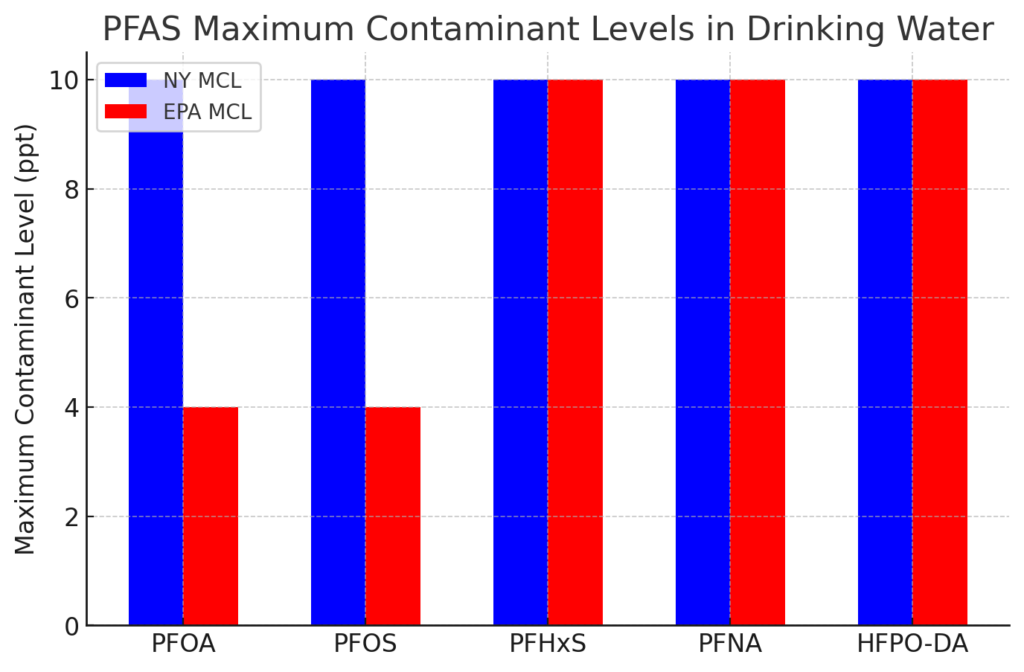
Maximum Contaminant Levels (MCLs) for PFOA, PFOS, and 1,4-Dioxane
New York State also set an MCL of 1 part per billion (ppb) for 1,4-dioxane, another emerging contaminant of concern. It was the first to develop an MCL for 1,4-dioxane. The state continues to work on passing additional drinking water standards and notification levels for up to 23 PFAS compounds.
| Contaminant | New York State MCL | EPA MCL |
|---|---|---|
| PFOA | 10 ppt | 4 ppt |
| PFOS | 10 ppt | 4 ppt |
| 1,4-Dioxane | 1 ppb | – |
New York State’s Proactive Approach to Developing Protective Standards
Compliance with these new standards is estimated to cost approximately $1.5 billion annually for public water suppliers in the United States. The EPA estimates that implementing the new rule will save about the same amount in healthcare costs. This is by preventing 10,000 deaths and significantly reducing illness.
Nearly $1 billion in funding has been announced through the Bipartisan Infrastructure Law for PFAS testing and treatment. This is part of a total investment of $9 billion to address PFAS and other emerging contaminants. An additional $12 billion is available for general drinking water improvements.
Public water systems have three years to complete initial monitoring for PFAS chemicals. They have five years to implement solutions if levels exceed the new standards. By taking a proactive approach, New York State continues to prioritize the health and safety of its residents.
Long Island City Water Standards: Compliance and Enforcement
Long Island City is dedicated to ensuring its drinking water meets or exceeds federal and state standards. The city collaborates with local health departments to monitor and enforce these standards. This focus on health and safety is a top priority for its residents.
When a water system finds an exceedance of a maximum contaminant level (MCL), it must notify the local health department immediately. If an MCL exceedance is confirmed, the water system works with the health department. Together, they inform the public and create a plan to lower contaminant levels within a set timeframe.
To illustrate the extent of compliance and enforcement efforts, consider the following statistics:
| Statistic | Value |
|---|---|
| Percentage of community water systems in compliance with EPA standards (2016) | Over 90% |
| Americans receiving tap water from community water systems | Over 286 million |
| Percentage of U.S. population served by large municipal water systems | 82% |
| Water systems with water quality violations (2015) | 9% (serving 21 million people) |
| Community water systems with SDWA health violations in an average year | 7-8% |
Long Island City is committed to maintaining high compliance with drinking water standards and addressing any exceedances promptly. Through regular monitoring, enforcement, and public notification, the city aims to safeguard the health and well-being of its residents. It ensures access to safe, clean drinking water.

The Role of Public Water Systems in Ensuring Safe Drinking Water
Public water systems are the unsung heroes in the fight for safe and clean drinking water. These systems, serving communities across Long Island City and the United States, are responsible for regularly monitoring water quality. They report their findings to ensure the water we drink meets strict safety standards.
The New York State Department of Health states that public water systems must test for over 140 contaminants. This includes microorganisms, chemicals, and radiological parameters. This rigorous monitoring process helps identify issues early, allowing for swift action to protect public health.
Regular Monitoring and Reporting Requirements
Public water systems must adhere to a strict schedule of monitoring and reporting. The frequency of testing varies based on the contaminant type and population size. For instance, systems serving more than 10,000 people must test for certain contaminants, like coliform bacteria, daily.
Systems also submit detailed reports to local health departments and the state. These reports detail contaminant levels, any violations of water quality standards, and steps to address issues.
Notifying Local Health Departments and the Public of Exceedances
If a public water system detects a contaminant level exceeding the maximum contaminant level (MCL), they must notify local health departments and the public promptly. This ensures residents are informed of any health risks. They can then take appropriate action, such as using an alternative water source or boiling their water before consumption.
Developing Action Plans to Reduce Contaminant Levels
When a public water system identifies a contaminant level exceeding the MCL, they must develop and implement an action plan. These plans may include identifying and addressing the contamination source, implementing additional treatment processes, upgrading infrastructure, or increasing monitoring and reporting frequency.
By working closely with local health departments and the state, public water systems can effectively reduce contaminant levels. This ensures the drinking water provided to their communities is safe and reliable.
Public water systems play a critical role in safeguarding the health and well-being of Long Island City residents. They consistently monitor, report, and take action to maintain the highest standards of drinking water quality.
Infrastructure Upgrades and Treatment Processes for Compliance
To meet drinking water standards, many systems must upgrade their infrastructure and improve treatment processes. These efforts are complex and take years to complete. Yet, the water remains safe for use during this time, as systems work to lower contaminant levels.
Infrastructure upgrades cover various aspects, such as:
- Upgrading or replacing aging pipelines and equipment
- Implementing advanced filtration systems like reverse osmosis (RO), ultrafiltration (UF), or deionization (DI)
- Installing continuous monitoring systems for real-time water quality data
- Expanding treatment plant capacity to meet growing demand
Water treatment processes are key to compliance. They include:
- Coagulation and flocculation to remove suspended particles
- Sedimentation to settle out larger particles
- Filtration to remove smaller particles and microorganisms
- Disinfection to inactivate any remaining pathogens
- Adsorption to remove dissolved contaminants like PFAS
Many water systems are adopting innovative methods like Build-Own-Operate (BOO) contracts. These contracts allow a private company to finance, build, and operate the infrastructure. The public entity then pays for the clean water delivered. This approach offers several benefits:
| Benefit | Description |
|---|---|
| Expedited timelines | BOO contracts streamline the procurement process, allowing for faster project completion |
| Cost savings | Transferring O&M responsibilities to the private sector reduces the risk of costly breakdowns and emergency repairs |
| Regulatory compliance | BOO agreements ensure ongoing compliance with increasingly strict water quality standards, such as PFAS regulations |
| Predictable budgeting | Customers pay for the clean water delivered, avoiding unexpected cost overruns associated with traditional design-bid-build models |
As water systems upgrade, it’s vital to inform the public about progress and any water quality impacts. Regular updates through reports, meetings, and online resources help build trust. This ensures the community has access to safe, clean drinking water that meets all standards.
Accessing Information About Your Local Water Quality
Knowing the quality of your drinking water is key to protecting your health and your family’s well-being. In the United States, 130 million people rely on groundwater for drinking water. About 43 million, or 15% of the population, use domestic wells as their main source. Community water systems serving 15 or more service connections must prepare and distribute an Annual Water Quality Report, also known as a Consumer Confidence Report (CCR).
To find out about your local water quality, follow these steps:
Contacting Your Local Water Supplier
Your water supplier is a great source for information on your drinking water quality. Systems serving 1,000 or more service connections have been required to prepare Annual Water Quality Reports, starting from 1996. Many systems on Long Island have been doing this even earlier, from 1988. Reach out to your water supplier to get the latest report or to ask about your water quality.
Reviewing Annual Water Quality Reports (Consumer Confidence Reports)
Consumer Confidence Reports (CCRs) give a detailed look at your local water quality. These reports list detected contaminants, their levels, and how they compare to state and federal standards. They also include information on non-detected contaminants, total water withdrawn, delivered, and lost, and the average water charge. If a system exceeds a drinking water standard, the report will explain the violation and include health effects language.
| System Size | Report Requirements |
|---|---|
| 1,000 or more service connections |
|
| Fewer than 1,000 service connections |
|
By reviewing your local water quality report and asking your water supplier any questions, you can stay informed and proactive about your drinking water’s safety and quality.
The Significance of Long Island City’s President’s Award for Distribution System Operation
Long Island City’s water supplier, Long Beach Utilities, has earned the President’s Award for Distribution System Operation. This honor comes from the Partnership for Safe Water, backed by the American Water Works Association, the U.S. Environmental Protection Agency, and other water organizations. It highlights the utility’s commitment to providing safe, high-quality drinking water to its residents.
This achievement showcases Long Beach Utilities’ relentless pursuit of excellence. They have optimized their distribution system operations, surpassing regulatory standards. Their focus on water quality and dedication to reliability are evident in their efforts to serve the Long Island City community.
The President’s Award is a significant milestone, acknowledging water suppliers that excel in water quality standards. Long Beach Utilities’ success in earning this award reflects their effective water treatment processes and proactive approach to addressing contaminants. Their regular monitoring and testing procedures are a testament to their commitment to quality.
This award reassures Long Island City residents that their water supplier prioritizes their health. It demonstrates the utility’s investment in modern infrastructure and rigorous quality control measures. Their dedication to staying at the forefront of industry best practices is evident.
Receiving the President’s Award, Long Beach Utilities has set a benchmark for distribution system operation. They serve as a model for water suppliers nationwide. This recognition validates the utility’s team’s hard work and expertise. It also emphasizes the critical role of safe, clean drinking water in maintaining community health and well-being.
Long Beach Utilities’ Commitment to Exceptional Drinking Water Quality
For over a century, Long Beach Utilities has been a cornerstone in providing safe drinking water to Long Beach. A team of dedicated professionals ensures the water meets or exceeds federal and state standards. Their focus on exceptional drinking water quality is shown through their thorough testing and optimization efforts.
Performing Thousands of Tests Annually
Long Beach Utilities conducts extensive annual testing to guarantee the water’s safety and quality. They test thousands of samples each year, examining a broad spectrum of contaminants. These tests include:
- Microbiological analysis
- Chemical and physical parameter testing
- Radiological monitoring
- Lead and copper testing
This rigorous testing schedule exceeds the minimum regulatory standards. It showcases Long Beach Utilities’ commitment to ensuring water quality.
Surpassing Regulatory Requirements through Distribution System Optimization
Long Beach Utilities also employs advanced distribution system optimization techniques to uphold water quality standards. These strategies include:
| Optimization Strategy | Benefits |
|---|---|
| Regular flushing and maintenance of water mains | Removes sediment and biofilm, improves water clarity and taste |
| Monitoring and adjusting chlorine residuals | Ensures adequate disinfection throughout the distribution system |
| Implementing state-of-the-art water treatment technologies | Removes contaminants and improves overall water quality |
By surpassing regulatory standards, Long Beach Utilities shows its steadfast commitment to delivering safe, high-quality drinking water to its residents.
Reviewing Long Beach Utilities’ Annual Water Quality Reports
Long Beach Utilities has been a cornerstone in water supply for over a century. It shows its dedication to transparency and public health by publishing its annual water quality report online. This report, known as the Consumer Confidence Report (CCR), is a federal mandate for public water systems. It provides a detailed look at the efforts to protect drinking water quality.
The department conducts tens of thousands of tests each year. It analyzes samples for over 100 contaminants in drinking water. This commitment has earned Long Beach Utilities the President’s Award for Distribution System Operation from the Partnership for Safe Water.
The 2023 Water Quality Report was released on July 1, 2024. It is available online for public review. Residents can also request a hard copy by contacting Long Beach Utilities. This makes it easy for the community to stay updated on their drinking water’s quality and the efforts to keep it safe.
Long Beach Utilities’ annual reports are a clear reflection of their commitment to public health and the environment. By examining these detailed Consumer Confidence Reports, residents can understand the thorough testing, monitoring, and treatment processes. These efforts ensure the delivery of clean, reliable drinking water to homes and businesses.
Long Beach’s Non-Lead Initial Inventories and Service Line Material Information
The Long Beach Utilities Department (LBUD) has taken a proactive approach to ensuring the safety and quality of its drinking water. They completed the first lead service line inventory well ahead of the U.S. EPA’s Lead and Copper Rule Revisions deadline of October 16, 2024. This shows the city’s commitment to providing residents with clean, lead-free water.
Unlike many cities across the United States, Long Beach has demonstrated its dedication to public health. They have thoroughly reviewed historical records and physical verification. The LBUD’s efforts have confirmed that the City of Long Beach has no lead or galvanized requiring replacement service lines in its distribution system. This includes both privately-owned and customer-owned service lines.
| City | Reported Lead Service Lines |
|---|---|
| Chicago | 387,000 |
| Cleveland | 235,000 |
| New York City | 112,000 |
| Detroit | 80,000 |
| Long Beach | 0 |
While cities like Chicago, Cleveland, and New York City have reported significant numbers of lead service lines, Long Beach stands out. It has prioritized the elimination of this hazardous material from its water infrastructure. By maintaining non-lead inventories and meticulously documenting service line material information, the LBUD ensures that residents can have confidence in the safety of their drinking water.
Comprehensive Review of Historical Records and Physical Verification
The LBUD’s success in creating a lead-free water distribution system can be attributed to its approach. They have reviewed historical records and conducted physical verifications comprehensively. By delving into the city’s archives and examining construction documents, the LBUD has confirmed the absence of lead service lines throughout Long Beach.
Ongoing Documentation and Updates to Initial Inventory
To maintain the integrity of its non-lead inventory, the LBUD has committed to ongoing documentation and updates. As the department continues to gather service line material information through normal operations, it will update the initial inventory. This proactive approach ensures that Long Beach residents can have peace of mind knowing that their drinking water is free from the risks associated with lead contamination.
“The Long Beach Utilities Department’s commitment to providing safe, lead-free drinking water is a testament to the city’s dedication to public health and well-being.” – Mayor of Long Beach

The Importance of Staying Informed About Your Drinking Water Quality
Living in Long Island City, it’s vital to keep up with your drinking water quality. This knowledge helps you make choices that benefit your health and that of your family. The Environmental Protection Agency (EPA) has set maximum contaminant levels (MCLs) for six PFAS compounds. These include PFOA, PFOS, GenX, PFBS, PFNA, and PFHxS.
Over 200 million Americans might be exposed to PFAS in their tap water. The EPA’s new standards are a significant step towards protecting millions from PFAS contamination. These standards target six PFAS compounds, addressing a long-standing issue that has lasted over 50 years.
| Statistic | Value |
|---|---|
| Americans potentially exposed to PFAS in tap water | Over 200 million |
| Community water systems in West Virginia with unsafe PFAS levels | 130 |
| PFAS compounds targeted by new EPA regulations | 6 (PFOA, PFOS, GenX, PFBS, PFNA, PFHxS) |
| Years PFAS in drinking water went unregulated | Over 50 |
By checking water quality reports and contacting local health departments, you can understand the impact on your health. The new regulations aim to prevent PFAS-related illnesses and save lives. This is a critical step towards addressing PFAS contamination and environmental justice.
Stay informed, stay healthy. Arm yourself with knowledge about your drinking water quality. This empowers you to make informed decisions for your family and community. Together, we can ensure safe drinking water for Long Island City residents, promoting public health for generations.
Empowering Long Island City Residents with Knowledge and Resources
Long Island City residents enjoy a vast array of water quality resources. These come from the combined efforts of local water suppliers, health departments, and groups like the Long Island Sound Study (LISS). Through public awareness and community engagement, these entities aim to arm residents with the knowledge to safeguard their drinking water.

The LIS Resilience Resource Hub, for instance, is a central hub for climate resilience. It offers databases, guides, and workshops to support sustainable projects across the region.
Governor Kathy Hochul has pledged a historic $6 billion for clean water initiatives. This includes a $500 million commitment for 2025, as part of her State of the State address. These funds will aid homeowners through various programs and support transformative projects through the Green Resiliency Grant (GRG) program. Hochul also proposes financial aid for private well owners facing emerging contaminants and a new grant for water system cybersecurity.
By staying informed and participating in these efforts, Long Island City residents can significantly contribute to protecting their drinking water. Accessing annual water quality reports, attending workshops, and engaging with local suppliers and health departments are key steps. As Hochul’s initiatives focus on clean water, sustainability, and green jobs, the future looks promising for Long Island City’s residents. They can look forward to a future where clean drinking water is available to everyone.
FAQ
Why is regular testing of drinking water essential in Long Island City?
Regular water testing is vital to detect contaminants and ensure water safety in Long Island City. Even with strict regulations, contaminants like lead, heavy metals, and volatile organic compounds (VOCs) can sometimes enter the water supply.
How do contaminants in drinking water impact public health?
Contaminants in drinking water pose significant health risks to Long Island City residents. Knowing what’s in the water is key to designing effective filtration solutions and protecting public health.
What is New York State’s role in protecting drinking water quality?
New York State is dedicated to reducing chemical exposure in drinking water. It works with the EPA and local health departments to protect public health and ensure compliance with drinking water standards. The state aims to align its standards with federal ones for all public drinking water systems.
What are PFAS, and why are they a concern in drinking water?
PFAS, or per- and polyfluoroalkyl substances, are used in many products and linked to health issues. New York State is setting drinking water standards for these contaminants, starting with PFOA and PFOS.
How does New York State regulate emerging contaminants in drinking water?
New York’s standards for emerging contaminants are among the strictest in the country. In 2020, the state set MCLs for PFOA and PFOS at 10 parts per trillion. It also set a standard for 1,4-dioxane at 1 part per billion. New York is leading in setting standards for up to 23 PFAS.
What happens when a public water system exceeds the maximum contaminant level (MCL)?
If an MCL is exceeded, the public water system must notify the local health department. They then work together to inform the public and develop a plan to reduce levels below the MCL.
How can residents access information about their local water quality?
Residents can find out about their local water quality by contacting their water supplier or reviewing annual water quality reports. These reports detail the water supplier’s efforts to ensure safe drinking water and are published online each year.
What is the significance of Long Beach Utilities receiving the President’s Award for Distribution System Operation?
The President’s Award for Distribution System Operation recognizes Long Beach Utilities for its commitment to quality water. This award shows their dedication to providing safe and reliable water to residents and businesses in the City of Long Beach.
How can Long Island City residents stay informed about their drinking water quality?
Staying informed about drinking water quality in Long Island City is essential for health and well-being. By accessing water quality reports and contacting local health departments, residents can understand the impact on their health and take steps to ensure safe drinking water.