Understanding the Fundamentals of Water Quality
Water quality is essential for our daily lives, affecting everything from cleaning to appliance performance. It’s influenced by mineral levels, pH balance, and chemical composition. These factors are critical in maintaining the functionality of our homes.
What Determines Water Quality
Several elements define water quality:
- Mineral concentrations (calcium and magnesium) that define hardness levels.
- pH levels determining acidity or alkalinity, affecting corrosion risks.
- Alkalinity levels buffering against sudden pH changes.
Its Role in Home Maintenance
Home maintenance and water quality are closely linked. Poor water quality can lead to:
Issue | Impact |
High mineral content | Forms scale, clogging pipes and reducing appliance lifespan. |
Unbalanced pH | Corrodes metal pipes or leaves soap scum on surfaces. |
Low alkalinity | Accelerates material degradation in plumbing fixtures. |
Regular testing and understanding these factors are key. They help households address issues before they become major problems. Proper maintenance prevents costly repairs and ensures cleaning products work effectively.
How Water Hardness is Measured
Measuring water hardness involves quantifying calcium and magnesium ions. These minerals are measured in mg/L water hardness. Levels determine if water is soft, hard, or very hard. Testing methods vary but all aim for accurate ion detection.
- Laboratory titration: Uses chemical reactions to calculate mineral content.
- Test strips: Dip-and-read strips for quick mg/L water hardness estimates.
- Electronic meters: Digital devices providing real-time mg/L readings.
Water Type | mg/L Range |
Soft | 0-60 mg/L |
Moderately Hard | 61-120 mg/L |
Hard | 121-180 mg/L |
Very Hard | 181+ mg/L |
Accurate water testing methods are essential for homeowners. They help understand the mineral content of their water. Home testing kits often display mg/L water hardness levels. Professional labs provide detailed reports. Regular checks are vital for maintaining appliances and plumbing systems.
Impact of Water Hardness on Household Appliances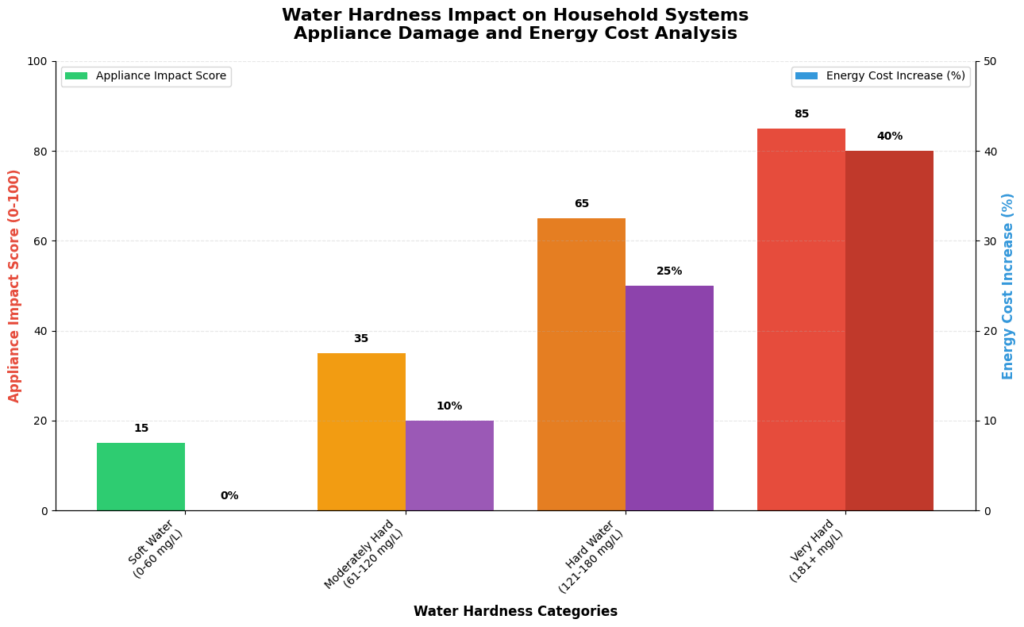
Hard water quietly damages household appliances by depositing minerals that lower their performance. These deposits, known as limescale, adhere to internal parts, causing appliance efficiency loss and increasing energy costs. Devices such as water heaters, washing machines, and coffee makers suffer from rapid deterioration due to scale buildup effects.
Scale Buildup and Efficiency Loss
Limescale forms when calcium and magnesium in hard water dry onto surfaces. In water heaters, this buildup insulates heating elements, requiring them to work longer to achieve desired temperatures. Dishwashers may leave cloudy spots on glassware, while coffee makers develop clogged brew heads. A study by the Rhode Island Water Resources Board revealed that scale reduces appliance lifespans by 20-30%, leading to significant repair and replacement costs for homeowners.
Scale buildup costs U.S. households over $1 billion annually in appliance-related expenses. — Environmental Protection Agency
Preventative Maintenance Tips
- Run vinegar-based descaling solutions through appliances quarterly to dissolve scale.
- Install whole-home water softeners to reduce mineral content before it reaches appliances.
- Follow manufacturer guidelines for household appliance care, paying special attention to coffee makers and humidifiers.
Regular inspections and simple cleaning routines can prevent expensive breakdowns. By prioritizing maintenance, we ensure appliances operate efficiently and safely for their entire lifespan.
The Connection Between Water Hardness and Health
Water hardness health concerns stem from minerals like calcium and magnesium. These minerals create mineral buildup health effects when dissolved in water. They can significantly impact personal care routines, affecting skin and hair health. For example, hard water reduces soap lather, leaving a residue that traps dirt and oils. This disrupts natural skin balance.
- Dryness: Hard water strips skin of natural oils, leading to irritation or eczema flare-ups.
- Scalp sensitivity: Mineral residues can clog hair follicles, causing dandruff-like symptoms.

Health Impact | Water Quality Link |
Reduced Hair Shine | Mineral deposits coat strands, hindering moisture retention. |
Skin Dryness | Soap films trap minerals, reducing skin’s hydration. |
Water quality and well-being are closely linked to daily hygiene practices. For instance, studies indicate that areas with extremely hard water experience more skin barrier disruptions. Using a water softener or pH-balanced cleansers can help mitigate these problems. Emphasizing water quality and well-being is essential for maintaining healthier skin and hair, supporting long-term health.
Identifying the Causes of Hard Water Formation
Hard water is a result of geological and environmental conditions. These causes of hard water vary by region, affecting water quality. Understanding these factors is key to effectively addressing water issues at home.
Natural Mineral Sources
Water becomes hard when it absorbs minerals from bedrock and soil. Key natural mineral sources include calcium and magnesium, found in limestone, gypsum, and dolomite. As groundwater moves through these formations, minerals dissolve, raising water hardness. For example, areas rich in limestone often have harder water.
- Calcium: Leached from limestone and marble
- Magnesium: Released from igneous and metamorphic rocks
- Sulfates: Dissolved from gypsum in aquifers
Environmental Influences
Environmental conditions also impact environmental impacts on water quality. Rainfall, soil type, and human activities alter mineral levels. Low rainfall can lead to higher mineral retention, while heavy rain dilutes them. Industrial waste, agricultural runoff, and mining introduce minerals into water supplies.
“Geology and climate work together to determine water hardness,” states the U.S. Geological Survey. “Human activity often amplifies these natural processes.”
Seasonal changes and land use practices cause hardness levels to fluctuate. Recognizing these factors helps households manage their water treatment needs more effectively.
Benefits of Softening Your Household Water
Switching to soft water brings water softening benefits that go beyond simple convenience. Homeowners quickly see improvements in their daily routines. For example, laundry washed in soft water stays brighter and softer. Dishes and glassware come out spot-free, without any residue.
- Appliances like washing machines and dishwashers work better, saving up to 29% on energy, as the Water Quality Association reports.
- Soft water advantages also mean longer-lasting appliances. This is because there’s less mineral buildup in pipes and heating elements.
- Soap lathers better, reducing the need for cleaning products by nearly 50%.
Hard Water Issue | Improving Water Quality Benefits |
Scaly deposits on fixtures | Eliminates soap scum, simplifying cleaning routines |
Higher energy bills | Appliances run optimally, lowering utility costs |
Worn clothing fibers | Fabrics stay stronger and last longer |
A study by the National Sanitation Foundation shows softened water cuts skin irritation by 65% in households with sensitive skin. These water softening benefits make homes healthier and protect investments in home infrastructure. By tackling mineral deposits early, homeowners can save about $300 a year on repairs and maintenance, as industry analyses suggest. Emphasizing improving water quality benefits turns daily tasks into efficient, cost-effective routines without losing performance.
Exploring water hardness Effects on Plumbing Systems
Hard water silently damages plumbing infrastructure, leaving more than just stains on dishes. Over time, mineral deposits transform into costly threats. This section examines how plumbing corrosion and pipe scaling arise, and their real-world financial consequences.
Plumbing Corrosion and Scaling
Minerals like calcium and magnesium in hard water cling to metal surfaces, forming pipe scaling. This buildup narrows water pathways, forcing systems to work harder. Over years, acidic minerals corrode metal pipes, weakening joints and valves. Common signs include reduced water pressure and discolored fixtures.
- Scaling: Calcium deposits narrow pipes, slowing water flow by up to 40%.
- Corrosion: Metal erosion leads to pinhole leaks, costing homeowners $500–$1,200 annually.
- System strain: Water heaters with plumbing corrosion lose 25% efficiency, increasing energy bills.
Economic Impact on Repairs
The economic impact of hard water extends beyond monthly utility bills. Emergency repairs for burst pipes or clogged drains drain budgets faster than softened water maintenance. A 2023 study by the American Water Works Association found that hard water-related plumbing issues cost U.S. households an average of $450 yearly in unexpected repairs.
Issue | Impact | Average Cost |
Scale buildup | Restricted water flow | $200–$600 (annual cleaning) |
Corroded fixtures | Leak risks | $800–$1,500 (replacement) |
Heater damage | Reduced lifespan | $300–$1,000 (premature replacement) |
“Hard water is the hidden tax on plumbing systems,” states the Plumbing-Heating-Cooling Contractors Association. “Proactive treatment saves homeowners thousands over a decade.”
Technological Advancements in Assessing Water Hardness
Modern digital water testing tools have revolutionized how we assess our water quality. These innovations make it easier to monitor water hardness and other key parameters. They provide accurate data for making informed decisions. Innovative water quality technology now fits seamlessly into our daily lives, ensuring both accessibility and precision.
Digital Testing Tools
Portable advanced water testing tools like handheld meters and smartphone-connected devices offer instant results. For instance, the PCE Instruments Water Hardness Meter provides lab-grade accuracy in seconds, eliminating the need for guesswork. Features like Bluetooth connectivity and cloud data storage make tracking trends simple.
Innovations in Home Water Testing
New innovative water quality technology includes:
- AI-driven sensors that predict hardness fluctuations,
- Self-calibrating strips for at-home use,
- Smart home systems that alert users to unsafe levels.
These advancements transform testing from a rare task into a routine check. This reduces long-term plumbing damage and health risks.
The Economics of Managing Hard Water
Managing hard water requires weighing water treatment cost against hard water economics. Initial costs are present, but the data indicates that investing in softening systems can lead to significant long-term savings water softening. For instance, a family of four can save over $1,550 annually by reducing maintenance and energy expenses.
“A whole-home water softener typically pays for itself in 20–26 months, with savings compounding over time.”
Cost of Water Treatment
Initial costs depend on the system type and home size. Salt-based ion exchange systems typically cost $800–$1,500. Salt-free alternatives start at $500. Annual costs for salt and maintenance range from $200–$400. Renters can opt for portable softeners, which cost $30–$60 monthly.
Long-term Savings Benefits
Softening systems offer savings in several areas:
- Cleaning products: Reduced soap/detergent use lowers costs by 50% ($450/year)
- Energy bills: Appliances run 20–30% more efficiently ($60/year)
- Appliances: Lifespans double for water heaters and dishwashers
Appliance | Lifespan with Hard Water | Lifespan with Soft Water |
Electric Water Heater | 6.5 years | 13 years |
Dishwasher | 7 years | 10 years |
Washing Machine | 9 years | 12 years |
Over a decade, households can save upwards of $15,600. This is achieved by avoiding premature replacements and lowering utility bills. The numbers clearly show that investing in softening systems can lead to a positive hard water economics outcome.
Regional Variations in Water Quality Across the United States
Water quality in the United States varies greatly by region. US water hardness levels vary significantly across states, influenced by geographical water variations and local geology. For example, areas with limestone bedrock, such as Texas or Arizona, often have very hard water. In contrast, coastal regions like Oregon or Washington have softer water due to volcanic rock.
- Great Plains and Southwest: High US water hardness (over 180 ppm) from calcium-rich limestone.
- Pacific Northwest: Soft water (under 50 ppm) from volcanic basalt deposits.
- Midwest: Moderate hardness (100–150 ppm) influenced by sandstone and clay.
These regional water quality differences impact daily life. In Florida, saltwater intrusion near coastlines increases chloride levels. The Northeast’s older pipes can leach metals into drinking water. The U.S. Geological Survey reports that 85% of Americans use hard water, highlighting significant regional contrasts.
Homeowners in hard-water zones often invest in softeners to protect appliances. In contrast, soft-water regions focus on iron or sulfur removal. Local water reports from the EPA or state agencies provide data on regional water quality. Testing kits reveal whether your area faces high mineral content or other issues.
“Geology and water sourcing create a patchwork of water quality across America,” says a 2023 EPA study. “Understanding local patterns helps residents choose effective solutions.”
Knowing your region’s US water hardness levels means tailored solutions. Check local utility reports or test kits to address your area’s specific challenges.
Environmental Insights on Preventing Water Hardness
Modern methods for reducing water hardness focus on eco-friendly solutions. Sustainable water treatment now aims to use fewer chemicals while keeping water usable. These efforts align with environmental water solutions that meet household needs while protecting the environment.
Sustainable Water Treatment Solutions
Chemical-free options like magnetic descalers and template-assisted crystallization systems are becoming popular. They prevent scale buildup without harming aquatic life. Reverse osmosis systems, when managed properly, also fit into sustainable water treatment categories. Homeowners can explore these options to lessen their environmental impact.
- Template-assisted crystallization: Converts minerals into harmless particles
- Magnetic descaling: Reduces scale formation using magnetic fields
Community Water Initiatives
Local efforts, such as community water initiatives, encourage collective action. Cities in Texas and California have launched free water testing drives to inform residents about hardness levels. Schools and utilities collaborate to teach water stewardship through practical projects. These efforts raise awareness and promote proactive management.
The EPA’s WaterSense partnership offers grants for eco-friendly installations in public buildings. Such initiatives show that small actions can lead to significant changes. For instance, the City of Phoenix saw a 30% decrease in water hardness complaints through public education.
Embracing these strategies helps build resilient water systems. Residents can visit this resource to discover more about the ecological effects. Taking proactive steps today ensures cleaner water for generations to come.
How to Interpret Your Water Test Results
Understanding water hardness and quality reports empowers homeowners to make smart choices about water treatment. Begin by identifying key measurements such as calcium and magnesium levels, which define water hardness. Here’s a guide to help you decipher your results:
- Identify hardness levels. Look for mg/L (parts per million) values. For instance, soft water is below 60 mg/L, and very hard is above 180 mg/L.
- Compare these values to EPA and NSF guidelines. If they exceed recommended levels, you might need a softening system.
- Also, check for contaminants like iron or chlorine to address specific problems.
Classification | Calcium Carbonate (mg/L) |
Soft | 0–60 |
Moderately Hard | 61–120 |
Hard | 121–180 |
Very Hard | >180 |
“Regular testing and proper interpretation prevent appliance damage and health risks,” says the EPA’s water quality guide. Follow these steps to avoid scale buildup or corrosion.
To interpret water test results, compare them to local standards. High hardness levels (over 120 mg/L) often require softeners. Low pH or high iron levels might need filtration. Discuss your findings with certified experts like Culligan or WaterTech for personalized advice. Taking action based on test results ensures safe and efficient water use at home.
Best Practices for Enhancing Home Water Quality
Improving home water quality begins with diligent care and vigilance. Simple actions like regular checks and proactive steps can avert expensive problems. They ensure the water we use daily is safe and clean.
Regular Maintenance Routines
Effective regular water maintenance hinges on consistent, simple actions. Homeowners should:
- Test water annually using at-home kits or lab services
- Replace water softener resin every 5-7 years to maintain efficiency
- Flush water heaters yearly to remove sediment buildup
Professional vs DIY Solutions
The choice between professional water treatment options and DIY methods depends on the issue’s severity and your expertise. For example:
- Professional services: Companies like Culligan or Hague Water provide tailored systems for severe hard water. This includes ion-exchange softeners and whole-house filtration.
- DIY approaches: Installing pitcher filters or descaling kettles can handle minor issues. Yet, they might not tackle deeper problems.
Professional solutions are best for areas with high mineral content. DIY fixes are suitable for low-to-moderate hardness levels. Often, a combination of both strategies yields the most effective results.
Debunking Common Myths About Water Hardness
Sorting through water hardness myths can feel overwhelming. This section cuts through confusion, clarifying hard vs soft water facts to help households make informed choices.
Myth: Hard Water is Always Bad
Many believe hard water harms health, but debunking water myths reveals a different story. The U.S. Geological Survey (USGS) notes that minerals like calcium in hard water are dietary supplements for millions. A 2023 study in the Journal of Environmental Health found no link between hard water and increased health risks. Key points:
- Hard water contains magnesium and calcium, essential nutrients.
- No evidence ties it to skin diseases or digestive issues.
- Over 80% of U.S. homes use hard water safely, per EPA data.
Myth: Soft Water Damages Plumbing
Softened water’s reputation for corroding pipes is another water hardness myth. NSF International confirms properly installed water softeners don’t damage systems. Properly maintained softeners remove scale, extending appliance life. Critical factors:
- Corrosion stems from poor salt regeneration, not soft water itself.
- NSF-certified systems prevent mineral buildup, protecting fixtures.
“Well-maintained softeners align with plumbing standards, reducing scale-related damage by 40%.” — NSF International, 2023 Report
Understanding these hard vs soft water facts empowers households to balance utility and safety without falling for outdated beliefs.
Final Thoughts on Safeguarding Home Water Integrity
Protecting water integrity at home is essential for both system longevity and financial health. Hard water, though safe to drink, can damage appliances and plumbing over time. For instance, using hard water in water heaters can increase energy costs by 25–40%. Appliances may also see their lifespan reduced by 30–50%.
Implementing home water protection strategies is critical. Regular water testing and targeted solutions are key. Installing water softeners or conditioners can prevent mineral buildup, keeping appliances running efficiently. Routine maintenance, such as vinegar-based cleaning or professional descaling, can also extend equipment life.
Homeowners should test their water annually to determine hardness levels. The U.S. Geological Survey’s hardness scale guide can help decide on the right softening system or conditioning agent. By taking these steps, residents can save money and ensure sustainable home water protection. Small actions today can prevent costly repairs and maintain household systems for years.
FAQ
Why is water hardness important?
Water hardness is key because it impacts both household systems and personal health. It’s about the minerals like calcium and magnesium in water. These minerals affect cleaning and how long appliances last.
What determines water quality?
Water quality comes from its chemical makeup, including minerals, pH, and contaminants. Geological formations and human activities also shape water quality.
How does water quality affect home maintenance?
Poor water quality can make cleaning less effective. It also wears down appliances faster. This means higher maintenance costs and shorter appliance lifespans.
How is water hardness measured?
Water hardness is measured with modern methods like titration or digital tools. Results show mineral levels in milligrams per liter (mg/L).
What are the effects of hard water on household appliances?
Hard water causes scale buildup in appliances. This reduces efficiency and increases repair needs. It also raises energy costs and can shorten appliance life.
What preventative maintenance tips can help with hard water issues?
Regular descaling and using water softeners help. Routine checks also prevent hard water damage. These steps extend appliance life.
How does water hardness impact health?
Hard water can dry out skin and hair. It also reduces soap lather. This can cause discomfort for users.
What causes hard water formation?
Hard water forms from minerals leached from rocks into water. Environmental factors like temperature and rainfall also play a role.
What are the benefits of softening household water?
Soft water improves appliance efficiency and cleaning results. It also lowers maintenance costs. This makes it a smart investment for homeowners.
How does hard water affect plumbing systems?
Hard water causes corrosion and scaling in plumbing. This increases leak and blockage risks. It also raises repair costs.
What are the economic aspects of managing hard water?
Water treatment costs may seem high at first. But, the long-term savings from better appliances and less repairs are significant.
Are there regional differences in water quality across the U.S.?
Yes, water quality varies across the U.S. due to local geology and environmental factors. This leads to different hardness levels in regions.
What environmentally friendly methods are available for controlling water hardness?
Eco-friendly options include using green water softeners and community water quality initiatives. These methods reduce chemical use while addressing hardness.
How can one interpret their water test results?
Understanding water test results means knowing the importance of each measurement. It helps decide if more treatment is needed based on the quality.
What are best practices for maintaining home water quality?
Regular maintenance, like plumbing inspections and appliance checks, ensures optimal water quality. It prevents costly issues before they arise.
What are some common myths about water hardness?
Myths include thinking hard water is bad for all uses and that soft water treatments harm plumbing. In fact, hard water has benefits, and many softeners are safe for plumbing.