Queens’ Water Supply: Understanding the E Coli Problem
- Published:
- Updated: November 30, 2024
Listen to this article
Summary
Queens faces a serious issue with E Coli contamination in its water supply.
- Health risks include severe digestive and kidney problems.
- Causes include aging infrastructure and fecal contamination.
- Solutions require both technological and community-driven efforts.

Water is clean — the first thing on our life list. But Queens’ own have been suffering from an exponential increase in E Coli contamination in their local water supplies. It’s not just a community problem, it’s a public health catastrophe and economic drag on one of the most populous boroughs in New York.
The Urgency of the Issue: Why You Should Care
Recently, E Coli contamination has been the sound of Queens and is a very direct threat to the population. Schools have had to be switched to bottled water, and restaurants and cafes have been closed for a while. Not only does it influence the everyday lives of its inhabitants but also makes them feel jittery and weak.
And the health risks can be grave. E Coli can cause everything from the most basic gastrointestinal condition to kidney failure, and it can be deadly to children as young as a child and the elderly in particular. Cost-effectively, contamination corrodes the market value of homes, since a healthy water supply is an important feature for a buyer’s home, and even depresses the sales of local businesses that rely on good water to function.
The Water Journey: From Source to Tap

Our water supply comes first from natural sources: rivers, lakes, reservoirs. They are also part of broader ecosystems and susceptible to all manner of contamination, including E Coli. We try to treat this water in municipal plants so that it can be used but we have to be aware that this path can get polluted at any time.
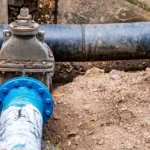
Water comes off that filter, then it is pumped along a complex set of pipes to get to our taps. While on this trip, outdated infrastructure, illegal ties or pipeline leaks all might be contaminated. Even in a city like Queens with its old plumbing, this part of the water flow is especially vulnerable to E Coli invasion.
Unveiling the Culprit: What is E Coli?
E Coli or Escherichia coli is one bacteria that can have all sorts of issues when it is swallowed. Not all E Coli species are bad, in fact, some are needed for healthy flora. But there are strains that cause diseases, which show up as severe diarrhoea, vomiting and abdominal cramping.
E Coli enters water supplies through faecal contamination – whether that’s from sewer overflow, agricultural discharge or poorly treated wastewater. If there is, it usually refers to a water treatment system breakdown and a failure of the system as a whole. What is most worrying about E Coli is that it is a kind of marker organism – the E Coli means that other toxicants might be in the water too.
The Detection Game: How is E Coli Found?
E Coli infestations are usually detected by water-borne illness reports by the people who live there. These allegations make local health departments test the water. This reactive mode works but periodic proactive action is the key to identifying and preventing contamination problems.
High-tech solutions such as membrane filtration, enzyme analysis and molecular techniques changed the detection of E Coli in waterways. All of these scientific advances can detect the disease faster and more precisely, which means public health agencies can respond faster. Alas, even with these technological improvements, there are still instances of E Coli that slip through, making citizen and government monitoring necessary.
Failed Safeguards: Where the System Broke Down
There is no shortage of historical failures and neglects that have brought us to the crisis. From water treatment plant underfunding to poor regulation, the problems are multi-layered. There are too many holes in the water safety rules, which has created gaps of unnecessary checks and apathy.
And also a difference between naivety and inevitable events. Storms and hurricanes, for example, can wreak havoc on water safety and often go uncontrollable. But being ready for these scenarios, and acting rapidly after them, can drastically reduce dangers.
Risk Factors: The Hidden Dangers in Your Home
If environmental sources are the primary drivers of water quality, then your home is also the primary source. There can be lead or iron-based plumbing systems that are decomposing as points of contamination. Water that comes into your home is clean but might not stay clean.
Changes in water quality occur during seasonal periods, too. When it rains or snows a lot, for instance, runoff could result in the increase in pollutants flowing into the water system. In the meantime, household appliances such as worn taps, clogged drains or even improperly cleaned water filters are just a part of the mix.
Think Global, Act Local: Comparing Queens to Other Regions
The E Coli outbreak isn’t just in Queens, it’s national and even international. But Queens has its own issues, from old infrastructure to density, that make the issue worse. While a rural system would have wells, Queens’ central water system is at higher risk for mass contamination.
Local policy can go a long way. Queens might make progress on water safety if it takes cues from other regions that have beat E Coli. You need to think about the local context but you also need to realize that this is part of a much broader, multilayered problem.
A Multi-Faceted Problem: It’s Not Just About E Coli
E Coli is a big concern, but you should know that it’s one part of a larger mess with multiple water contaminants. Here are some other common culprits:
Lead: An addictive neurotoxin with long-term cognitive effects.
Chlorine: It is disinfecting but if taken in too much, you might suffer from respiratory symptoms.
Arsenic: Chronic illnesses are possible with exposure over the long-term.
If it has E Coli, the likelihood of these other contaminants will be present. It’s the pigeon in the coal mine for water quality and it’s an indicator that your whole water treatment system is going wrong on a number of fronts, so you have to be creative with your solutions.
Your Role in the Solution: How You Can Make a Difference
Public education is the first step to an answer. A little thing such as a good water filter or simply scrubbing your tank can go a long way. Just as we depend on the city to provide water, so the city depends on us to make complaints. It will be your keen eyes that do the rest.
Public relations is also an important aspect. Working in local projects that aim to protect water can also be interesting. Just as effectively, getting your point across in public meetings or at the level of policymakers can lead to change. A literate, vocal community demanding clean water can change everything.
The Path Forward: Emerging Solutions and Innovations
We’re seeing some innovative technology to fight E Coli and other water pollutants. High purity levels of water, for instance, are provided by the new UV and nanofiltration treatments. Such advancements offer promise that a permanent cure for the E Coli outbreak is possible.
Legislative measures are equally important. More rigid rules, more regular inspections, more money to build water treatment facilities can stop it at its tracks. Collective action combined with state intervention can lead to a multi-tiered water safety solution.
Impact of Climate Change on Water Contamination
Queens Water contamination skewed by climate change. Overflowing wastewater treatment facilities and a greater chance of E Coli contamination in the water supply are possible with more rain and storms. Learn how climate change impacts water quality to make resilient infrastructure and mitigation decisions.
Conclusion: Queens' Water Supply and E Coli
Final thoughts: the explosion of E Coli contamination in Queens’ drinking water poses a serious public health threat. This is a problem that needs to be tackled in the whole picture, through sophisticated detection, better infrastructure and citizen engagement. Clean, safe water for everyone living there is a public good that needs monitoring and education.
Share this on social media:
Facebook
Twitter
LinkedIn