Manganese in Drinking Water: Understanding the Hidden Risks
- Published:
- Updated: November 27, 2024
Listen to this article
Summary
Explore the risks associated with manganese in drinking water:
- Health Effects: Excessive manganese intake can lead to short-term aesthetic issues and long-term neurotoxic effects, particularly impacting vulnerable populations like children and the elderly.
- Detection and Removal: Water testing and various treatment methods, such as oxidation filtration and ion exchange, are crucial for identifying and mitigating manganese contamination.
- Global Perspective: Manganese contamination is a global concern, emphasizing the importance of public awareness, prevention measures, and advocacy for effective water quality regulations.

Learn more about the secret hazards of manganese in tap water as we learn more about how this rarely seen substance can be a danger to our health and wellbeing. Manganese is a mineral that we need in tiny quantities, but when consumed in large quantities in the water supply it causes health issues. If we know where manganese comes from, its health hazards and precautions for drinking water, then we can make choices and do the necessary things to ensure we and those we care about are safe from these potential unintentional dangers.
The Basics of Manganese
Manganese is a naturally occurring mineral in crust, rocks, soil and many foods. We humans require it, but only in tiny quantities, and for a host of bodily functions, including metabolism, bone growth and nervous system functioning. But even good, manganese can be extremely harmful if it is added to our water in too high a concentration.
Where does manganese end up in our water? It usually gets into water when water seeps in through manganese-rich rocks and soil. This is common in groundwater sources but can also happen in surface water that interacts heavily with local geology.
The Safe Levels of Manganese in Drinking Water

Public health agencies and regulatory agencies all over the world – from the World Health Organization (WHO) to the US Environmental Protection Agency (EPA) – established limits of manganese in water for consumption and the methods for testing for manganese in drinking water. In the WHO’s guideline value (mainly for taste and stains), the aesthetic value is 0.1 mg per litre. The EPA recommends the same level as a health advisory (which means that you might have health issues if you continuously exceed it).
They’re set based on an equalisation of nutritive value and risk for illness, given that too high a concentration can be harmful. Note that these guidelines might vary from country to country, as the manganese content of your diet.
What are the health effects of excessive intake of manganese?
Manganese in excess, especially when taken in the form of drinking water, has various health side effects. The long-term effects of manganese-rich levels include odour and stains on clothes and furniture.
If exposed to manganese for a long period or a very long time, though, then health issues can be more severe. These could include neurotoxic changes in memory, attention and motor functions. It can, at its worst, develop into a syndrome with the symptoms of Parkinson’s.
Special Risks for Children and Vulnerable Populations
There are some populations that are especially prone to excess manganese. Babies and children, for instance, are especially vulnerable because they have less developed nervous systems and drink more water per kilogram of body weight.
Older adults and those with liver disease also have a higher chance, as manganese excretion slows down with age and liver disease. As a result, these people should be especially concerned about manganese in the water they drink.
Methods of Detecting Manganese in Water
When looking for manganese in water, this usually takes place through the analysis of water in the lab. The water samples are collected and processed using atomic absorption spectroscopy or inductively coupled plasma mass spectrometry (two technologies that measure manganese concentrations in water).
You should check drinking water frequently for manganese, particularly if it is private – a well, for example – and not regulated like public water. There are water testing kits available as well for those homeowners who want to try some initial testing themselves.
What techniques can be used to remove manganese from water?
If your water supply contains high levels of manganese, there are several effective treatment options to consider:
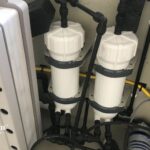
- Oxidation and Filtration: This is a common method where manganese is oxidized to form solid particles that are then removed through filtration.
- Ion Exchange: Similar to a water softener, this process uses a resin to swap manganese ions with other ions, usually sodium.
- Reverse Osmosis: This high-tech method uses a semi-permeable membrane to remove manganese along with other contaminants.
Each of these methods has pros and cons, and the best choice depends on factors such as the specific manganese concentration, the presence of other contaminants, and the volume of water needing treatment.
Local and Global Perspective on Manganese Contamination
Manganese contamination in water supply is a problem worldwide, for both developed and developing nations. For example, in Bangladesh, where naturally occurring arsenic in the groundwater is a known problem, manganese has also been found in high concentrations, with massive health risks to millions of people.
In the United States, too, there have been some areas identified where groundwater exceeds the EPA’s health advisory for manganese. These are examples of why we should check water frequently and treat it appropriately, no matter where you live.
Public Awareness and Prevention Measures
Restrictions and treatment protocols matter, but public awareness is an essential part of coping with manganese in water. Better understanding of where manganese comes from, what health hazards it poses, and how to detect and prevent it can equip individuals and communities to take action.
We can help keep it from happening by having regular water test, especially on the private wells, and put in water treatment units when necessary. Efforts in promoting good water quality standards are also an important part of the action to avoid manganese contamination.
Share this on social media:
Facebook
Twitter
LinkedIn

Related Posts