

Understanding Volatile Organic Compounds (VOCs)
Volatile Organic Compounds, or VOCs, are a group of airborne chemicals that significantly affect indoor air quality. These gaseous compounds come from various everyday products and materials. They continuously release vapors into the air we breathe. The definition of VOCs includes a wide range of substances, both harmful and harmless. It’s essential to understand their sources and health effects.
VOCs are common in our homes and workplaces. Sources include paints, varnishes, cleaning agents, disinfectants, cosmetics, fuels, and building materials. These reactive substances can stay in indoor environments for a long time. This leads to chronic exposure. Safe levels of total VOCs are generally considered to be lower than 0.5 mg/m³. Even low concentrations can cause health problems in some individuals.

The Impact of VOCs on Indoor Air Quality
The presence of VOCs in indoor air can cause indoor air pollution. In poorly ventilated spaces, VOCs can reach levels several times higher than outdoors. This can lead to health issues, from mild symptoms like eye, nose, and throat irritation, headaches, and dizziness, to more severe problems like allergic reactions, liver and kidney damage, and an increased risk of cancer.
To assess VOCs’ impact on indoor air quality, continuous monitoring is essential. VOCs are measured in micrograms per cubic meter (µg/m³), milligrams per cubic meter (mg/m³), parts per million (ppm), or parts per billion (ppb). Professionals use instruments like the TSI AirAssure™ IAQ Monitors and TSI Q-Trak™ XP Indoor Air Quality Monitor to track VOC levels and identify pollution sources.
Understanding VOCs and their impact on indoor air quality helps us minimize exposure. We can choose low-VOC products, improve ventilation, and regularly monitor indoor air quality. This ensures VOC levels stay within safe limits, creating healthier living and working environments.

Common Sources of VOCs in Homes and Offices
Volatile Organic Compounds (VOCs) are everywhere in our daily lives. They come from common household items and building materials. These chemicals can turn into gases at room temperature, affecting indoor air quality. Knowing where VOCs come from is key to making our living and working spaces healthier.
Building Materials and Furnishings
Many building materials and furnishings release VOCs. Pressed wood products, like particleboard and fiberboard, often contain formaldehyde. This VOC can be present in concentrations up to 0.3 ppm. Carpets and new furniture also release VOCs for weeks or months after they’re installed.
To reduce VOC emissions from flooring, look for products labeled as "low VOC," "ULEF" (ultra low emitting formaldehyde), or "NAUF" (no added urea formaldehyde).
Cleaning Products and Personal Care Items
Traditional cleaning products and personal care items are big sources of VOCs. Some household cleaning products can have up to 20% VOCs by weight. Air fresheners and scented candles emit VOCs continuously, even when not in use.

To lower exposure, choose low-VOC alternatives. Here are some options:
| Product Category | Low-VOC Alternative |
|---|---|
| Cleaning Products | Ecover’s Zero range, Delphis Eco |
| Personal Care Items | Fragrance-free, natural, or organic products |
Paints, Varnishes, and Adhesives
Paints, varnishes, and adhesives are known for their high VOC content. Traditional paints can release VOCs long after drying, polluting indoor air. The British Coatings Federation categorizes VOC content in paints as follows:
- Trace: VOC content <0.1%
- Minimal: VOC content 0.1–0.29%
- Low: VOC content 0.30–7.99%
- Medium: VOC content 8–24.99%
- High: VOC content 25–50%
To minimize VOC exposure, pick low-VOC or zero-VOC paints and finishes. Also, ensure proper ventilation during and after application.
By understanding and addressing these common VOC sources, we can improve indoor air quality. This leads to healthier living and working spaces.
Health Effects of VOC Exposure
Exposure to volatile organic compounds (VOCs) can have significant health impacts, both in the short-term and long-term. VOCs are emitted into the air from various products and processes, with some known to cause cancer. Children, the elderly, and those with pre-existing health conditions are most vulnerable to VOC exposure.
In the short-term, VOC exposure can cause a range of symptoms. These include:
- Irritation of the eyes, nose, and throat
- Difficulty breathing and nausea
- Headaches and dizziness
- Allergic skin reactions
- Fatigue and nausea
Long-term exposure to VOCs can lead to more severe health consequences. These include:
- Damage to the central nervous system and other organs
- Increased risk of respiratory issues, including asthma
- Potential to cause cancer, from exposure to known carcinogens like formaldehyde
- Chronic allergic reactions and skin sensitivities
Vulnerable Populations
Certain groups are more susceptible to VOC exposure. Children, for example, are more vulnerable due to their developing respiratory and immune systems. They also tend to breathe more air relative to their body size, increasing their exposure to airborne pollutants like VOCs.
The elderly and those with pre-existing health conditions, such as asthma or other respiratory issues, are also at higher risk. Exposure to VOCs can exacerbate their symptoms and lead to more frequent or severe health complications.
According to the Environmental Protection Agency (EPA), VOC levels can be up to 10 times higher indoors than outdoors. This is concerning, as people spend a significant portion of their time indoors. Ensuring proper ventilation and reducing the use of high-VOC products can help minimize exposure and protect vulnerable populations.
VOCs in Everyday Life: A Closer Look
Volatile Organic Compounds (VOCs) are everywhere in our daily lives, found in the air we breathe and the products we use. Indoor environments often have VOC concentrations 2 to 5 times higher than outdoors. This is due to poor ventilation and the continuous use of items that release VOCs. Given that we spend over 90% of our time indoors, it’s vital to understand VOC sources and make informed product choices to reduce our exposure.
Many household items contribute to indoor VOC levels. Paints, glues, and cleaning products contain VOCs like aliphatic hydrocarbons, ethyl acetate, glycol ethers, and acetone. Compressed aerosols alone emit 1.3 billion tons of VOCs globally each year. Fragrances in cosmetic products are also a significant source of VOCs, with the International Fragrance Association listing over 3,600 possible ingredients, many of which are harmful.
| Source | Common VOCs | Potential Health Effects |
|---|---|---|
| Paints and Coatings | Aliphatic hydrocarbons, ethyl acetate, glycol ethers, acetone | Eye and throat irritation, headaches, dizziness, respiratory issues |
| Cleaning Products | Isopropyl alcohol, methylene chloride, perchloroethylene | Organ damage, immune system suppression, increased cancer risks |
| Personal Care Products | Fragrance compounds, benzene, formaldehyde | Endocrine disruption, developmental toxicity, cancer |
Exposure to VOCs can happen through inhalation, direct contact, and drinking water. People working in environments where VOCs are used, like construction and renovation, face higher risks. Vapor intrusion can also contaminate soil and groundwater, affecting indoor air quality. Long-term exposure to VOCs like benzene and formaldehyde can lead to immune system suppression, organ damage, and increased cancer risks.
To minimize VOC exposure, choosing low-VOC alternatives is essential. Reading labels and understanding certifications helps identify products with lower VOC content. Improving ventilation, using air purifiers with activated carbon filters, and adopting proper cooking and cleaning practices can also reduce VOC concentrations. By being aware of VOC sources and making informed choices, we can create healthier living spaces and reduce our daily exposure to these harmful compounds.
Identifying High-VOC Products
To keep your indoor space healthy, it’s vital to spot and cut down on high-VOC products. Volatile Organic Compounds (VOCs) are harmful chemicals that can release from various household items. This leads to poor indoor air quality and health risks. By learning to read labels and choosing low-emission materials and natural ingredients, you can lessen your exposure to VOCs.
Reading Labels and Understanding Certifications
When you’re shopping for household items, make sure to read labels thoroughly. Look out for terms like "solvent-based," "oil-based," or "aerosol," which usually mean high VOC content. On the flip side, products with eco-labels or green certifications generally have lower VOC levels. Some well-known certifications to look for include:
- GREENGUARD Certified
- EcoLogo Certified
- Green Seal Certified
- EPA Safer Choice
Choosing Low-VOC Alternatives
Whenever you can, go for low-VOC or VOC-free options to cut down on harmful chemical exposure. Here are some tips for making better choices:
- Opt for water-based, natural, or plant-based products over solvent-based ones
- Avoid products with strong smells or those that need special ventilation when used
- Prefer solid wood furniture over pressed wood or particle board, which often has formaldehyde
- Use natural cleaning solutions like vinegar, baking soda, and lemon juice when you can
By making smart choices and focusing on low-emission materials and natural ingredients, you can greatly reduce VOC levels in your home or office. This creates a healthier indoor environment for you and your family.

Improving Ventilation to Reduce VOC Concentrations
Volatile Organic Compounds (VOCs) come from various sources in our homes and offices. These include paints, solvents, carpeting, and cleaning products. They significantly contribute to indoor air pollution. In fact, indoor air can be up to 70% more polluted than outdoor air. VOC concentrations indoors can be 10 times higher than outdoors. To combat this, proper ventilation and the use of air purifiers with activated carbon filters are essential.
Effective ventilation is key to reducing VOC levels indoors. One simple yet powerful method is to keep windows open for a few hours each day. This allows fresh air to circulate and disperse accumulated VOCs. This practice promotes better air circulation and fresh air exchange, significantly improving indoor air quality. Also, installing and maintaining appropriate HVAC systems ensures adequate air exchange throughout the building. This further minimizes VOC concentrations.
Ventilation Techniques and Strategies
To optimize ventilation and reduce VOC levels, consider the following techniques:
- Open windows and doors regularly to promote natural air circulation
- Install exhaust fans in high-moisture areas like kitchens and bathrooms
- Utilize fresh air appliances such as HRVs (Heat Recovery Ventilators) or ERVs (Energy Recovery Ventilators)
- Ensure proper maintenance of HVAC systems, including regular filter changes and duct cleaning
Air Purifiers with Activated Carbon Filters
Air purifiers equipped with activated carbon filters can effectively remove VOCs from the air through adsorption. These filters are designed to trap VOCs and other harmful gases. They are a valuable tool in improving indoor air quality. Some notable air purifier models, such as Rabbit Air’s A3 and MinusA2, are wall-mountable. They are suitable for smaller spaces.
| Air Purifier Model | Filtration Technology | Suitable Room Size |
|---|---|---|
| Rabbit Air A3 | Activated Carbon, HEPA | Up to 1,070 sq. ft. |
| Rabbit Air MinusA2 | Activated Carbon, HEPA | Up to 815 sq. ft. |
| Blueair Classic 605 | Activated Carbon, HEPASilent | Up to 775 sq. ft. |
By combining proper ventilation techniques with the use of air purifiers featuring activated carbon filters, you can effectively reduce VOC concentrations. This creates a healthier indoor environment for you and your loved ones.
Minimizing VOC Emissions from Human Activities
Our daily habits significantly impact indoor air quality, alongside the pollutants from building materials. By choosing wisely in cooking, cleaning, and personal care, we can cut down VOC levels. This approach helps us avoid harmful substances in our homes and workplaces.
Cooking can release VOCs into the air. Using exhaust fans or opening windows while cooking is key. This allows fumes and odors to escape quickly. Choosing appliances with built-in ventilation systems also helps reduce VOC buildup.

Green Cleaning Practices
Green cleaning is vital for reducing VOC emissions. Many cleaning products contain VOCs that can stay in the air for a long time. Opting for low-VOC or natural cleaning products, like vinegar and baking soda, is a better choice. These alternatives are effective and improve indoor air quality.
Personal Care Product Selection
Personal care items, such as cosmetics and perfumes, also release VOCs. Choosing natural cosmetics with minimal fragrances and organic ingredients is best. Look for products with certifications that confirm their low-VOC content and environmental safety.
| Product Category | Key Considerations |
|---|---|
| Cleaning Products | Choose low-VOC or natural alternatives; avoid aerosol sprays |
| Personal Care Items | Select products with minimal fragrances and organic ingredients |
| Cooking Appliances | Opt for models with built-in ventilation systems |
Making informed choices in our daily lives can greatly reduce VOC levels indoors. Embracing green cleaning and using natural cosmetics are key. Proper ventilation in our living spaces is also essential. By being mindful of our household habits, we can create healthier environments for ourselves and our families.
Formaldehyde: A Common Indoor VOC
Formaldehyde, a widespread volatile organic compound (VOC), is found in many building materials and household items. Indoor VOC levels can be 10 times higher than outdoors, with people spending about 90% of their time inside. It’s vital to grasp the sources and health impacts of formaldehyde exposure for a healthy home environment.
Sources of Formaldehyde in Homes
Formaldehyde is common in pressed wood products like furniture, cabinets, and particleboard, as well as insulation. These products contain formaldehyde-based resins that release VOCs over time. New furniture, including carpets and upholstered items, also emits more formaldehyde initially, which decreases over time. The annual production of formaldehyde by manufacturers adds to its widespread presence.
Health Effects of Formaldehyde Exposure
Formaldehyde exposure can cause various health issues, based on concentration and duration. Short-term effects include respiratory irritation, headaches, dizziness, and nausea. Exposure to 10-20 ppm can cause eye irritation and a burning sensation in the nose or throat. Higher concentrations can lead to serious respiratory damage in minutes.
Long-term exposure is linked to chronic respiratory conditions like asthma and bronchitis. The International Agency for Research on Cancer classifies formaldehyde as a Group 1 carcinogen, indicating a cancer risk.
Reducing Formaldehyde Levels Indoors
To reduce formaldehyde exposure and improve indoor air quality, consider these strategies:
- Opt for low-emitting products, such as those certified by GREENGUARD or CRI Green Label Plus, for furniture, flooring, and other items.
- Ensure proper ventilation by opening windows and using exhaust fans to reduce VOC accumulation.
- Maintain moderate temperature and humidity levels to minimize formaldehyde emissions from pressed wood products.
- Allow new furniture and furnishings to off-gas in a well-ventilated area before bringing them indoors, or choose solid wood or low-emitting alternatives.
By understanding formaldehyde’s sources and health impacts and implementing strategies to reduce it, individuals can create a healthier living space. This minimizes the risks associated with this common indoor VOC.
VOCs and Outdoor Air Pollution
Volatile organic compounds (VOCs) are not just a concern indoors; they also affect the air we breathe outside. Outdoor pollutants can enter our homes and workplaces, adding to the complex mix of VOCs indoors.
Outdoor sources of VOCs
Vehicle emissions, industrial pollutants, and chemical solvents are the main outdoor sources of VOCs. Vehicles burning gasoline and diesel fuel release VOCs like benzene and formaldehyde into the air. Industrial activities and the use of chemical solvents also contribute to outdoor VOC levels.
These VOCs can react with other substances in sunlight, creating ground-level ozone and smog. Ozone, a key smog component, is highly reactive and can cause respiratory problems and worsen health conditions like asthma.
Impact of outdoor VOCs on indoor air quality
Outdoor VOCs can enter our homes and offices through infiltration. This happens when polluted air enters through windows, doors, and ventilation systems. Once inside, these VOCs combine with indoor emissions, potentially increasing overall concentrations and reducing air quality.
| Outdoor VOC Source | Primary VOCs Emitted | Indoor Infiltration Pathways |
|---|---|---|
| Vehicle emissions | Benzene, formaldehyde, acetaldehyde | Windows, doors, ventilation systems |
| Industrial pollutants | Toluene, xylenes, ethylbenzene | Air leaks, cracks in foundation |
| Chemical solvents | Perchloroethylene, methylene chloride | Attached garages, air intakes |
To reduce the impact of outdoor VOCs on indoor air, maintaining proper ventilation and filtration is key. Regular HVAC system maintenance and using HEPA filters can help block outdoor pollutants. Sealing air leaks and ensuring attached garages are well-ventilated also helps keep VOCs out of living spaces.

Testing for VOCs in Your Home
Volatile Organic Compounds (VOCs) are chemicals found in household items like paints and cleaning agents. They contribute to indoor air pollution and can cause health issues. These range from mild symptoms to severe respiratory problems. It’s vital to monitor and control VOC levels in your home for a healthy environment.
DIY Home Air Quality Test Kits
DIY home air quality test kits are an option for checking VOC levels. These kits collect air samples and send them for analysis. They offer insights into airborne chemicals, including VOCs. Though cheaper, they might not be as detailed or accurate as professional services.
Professional Air Quality Testing Services
Professional air quality testing services provide a deeper look at VOC levels. They use advanced equipment and sampling methods to measure pollutants. This gives detailed data and reports, helping to pinpoint VOC sources and improve air quality.
The cost of professional indoor air testing varies. It depends on the testing complexity and pollutants assessed. Prices usually range from $200 to $800. Here’s a comparison of DIY kits and professional services:
| Feature | DIY Test Kits | Professional Testing Services |
|---|---|---|
| Cost | $50 – $200 | $200 – $800 |
| Accuracy | Moderate | High |
| Comprehensiveness | Limited | Extensive |
| Pollutants Tested | VOCs, CO2, PM | VOCs, CO2, PM, Radon, Mold, etc. |
Choosing the right testing method is key to a healthy home. Regular indoor air monitoring helps identify and address VOC sources. This improves your home’s air quality and protects your family’s health.
Strategies for Reducing VOC Levels After Testing
When indoor air quality (IAQ) testing shows high levels of volatile organic compounds (VOCs), immediate action is necessary. VOCs can be up to 10 times more prevalent indoors than outdoors. In European and UK homes, 65 different VOCs have been identified. The first step in reducing VOCs is source control, which involves identifying and removing the main sources of these pollutants.
Building materials and furniture are responsible for 80% of VOCs found indoors. On the other hand, products like hairsprays and air fresheners contribute to 63% of VOCs. This highlights the importance of addressing these sources directly.
Increasing ventilation is another effective method for lowering VOC levels. Techniques like opening windows and using exhaust fans can dilute indoor pollutants by up to 90%. Air purification is also beneficial in removing VOCs from the air. Air purifiers with activated carbon filters are highly effective at capturing gases and chemicals.
Plants like English Ivy can also help, reducing airborne toxins by up to 60%. This shows that natural solutions can complement technological ones in improving air quality.
In some cases, remediation is needed to tackle persistent VOC problems. This might involve sealing or encapsulating materials that release VOCs, like painting over particleboard or replacing old carpeting. It’s essential to use low-VOC or VOC-free products during remediation. These products emit fewer than 50 grams of VOCs per liter, compared to conventional products that can release VOCs for months or years.
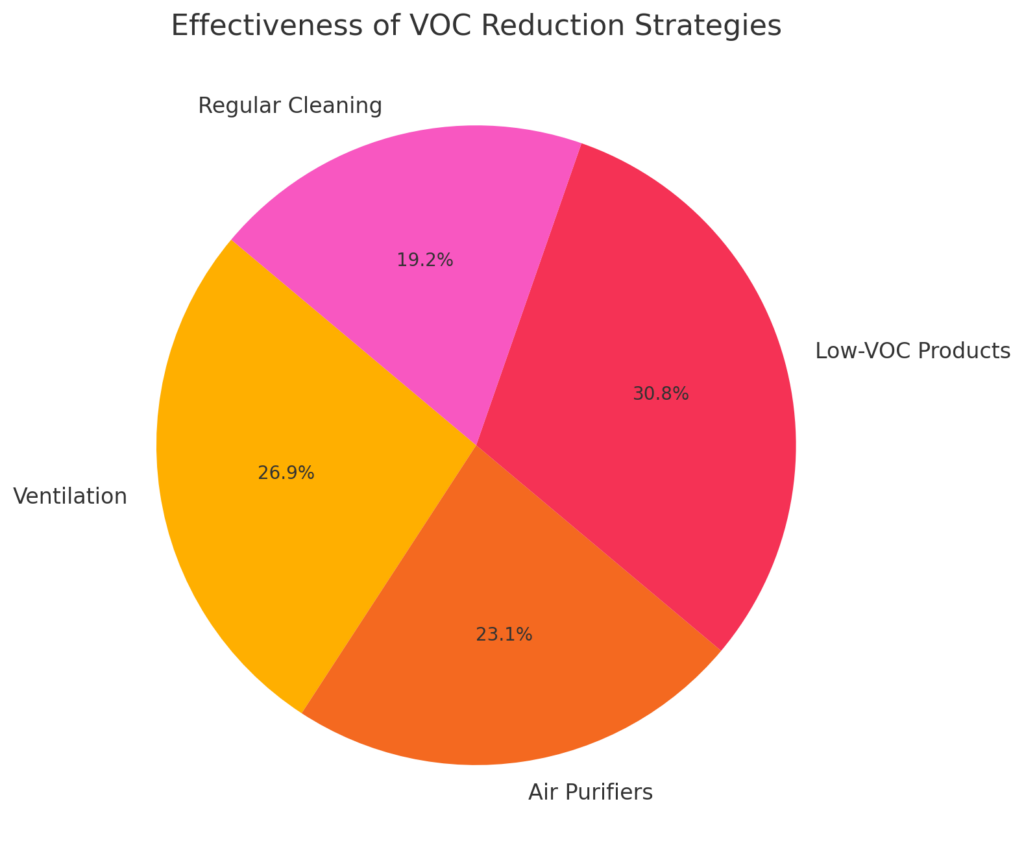
Regular cleaning can also help reduce VOC levels, as dust particles can trap VOCs. Maintaining humidity levels between 40-60% is also critical, as high humidity can increase VOC emissions. By combining source control, increased ventilation, air purification, and remediation, it’s possible to greatly enhance indoor air quality and create a healthier environment.
The Role of Ventilation Standards in Controlling VOCs
Ventilation standards are vital for maintaining healthy indoor air quality and reducing VOC exposure. People spend up to 90% of their time indoors, where air can be 2 to 10 times more polluted than outside. It’s essential to follow building codes and air quality guidelines to ensure a safe and comfortable environment.
ASHRAE 62.1 and 62.2 are key standards for ventilation requirements. They specify minimum ventilation rates for acceptable indoor air quality in commercial and residential buildings. ASHRAE Standard 62.1 provides guidelines based on space usage type, square footage, and expected maximum occupants. This ensures adequate fresh air is supplied to dilute and remove pollutants, including VOCs.
ASHRAE 62.1 and 62.2 standards
ASHRAE 62.1 and 62.2 standards are critical for maintaining proper ventilation and reducing VOC concentrations in buildings. These standards outline the minimum ventilation rates required for various types of spaces. They consider factors such as occupancy, floor area, and the specific activities conducted within each space. By adhering to these guidelines, building managers and homeowners can ensure their indoor environments are supplied with adequate fresh air to dilute and remove pollutants, including VOCs.
California OEHHA Reference Exposure Levels (RELs)
In addition to ASHRAE standards, the California Office of Environmental Health Hazard Assessment (OEHHA) has established Reference Exposure Levels (RELs) for various air pollutants, including VOCs. These RELs serve as indoor pollution limits, guiding exposure levels to protect public health. For example, the OEHHA recommends that classrooms with formaldehyde levels above 27 parts per billion (ppb) implement measures to reduce exposure. The goal is to achieve levels below 5-10 ppb.
| Standard | Description | Impact on VOC Control |
|---|---|---|
| ASHRAE 62.1 | Ventilation for Acceptable Indoor Air Quality in Commercial Buildings | Specifies minimum ventilation rates based on space usage, occupancy, and floor area to dilute and remove pollutants, including VOCs |
| ASHRAE 62.2 | Ventilation and Acceptable Indoor Air Quality in Residential Buildings | Provides guidelines for residential ventilation to maintain healthy indoor air quality and reduce VOC concentrations |
| California OEHHA RELs | Reference Exposure Levels for air pollutants, including VOCs | Establishes exposure limits to guide indoor pollution control and protect public health |
Smart Ventilation Systems for VOC Management
Creating healthier indoor spaces is a top priority, and managing volatile organic compounds (VOCs) is key. Smart ventilation systems are a cutting-edge solution. They combine advanced sensors with demand-controlled ventilation. This not only improves air quality but also boosts energy efficiency by adjusting ventilation based on pollutant levels.
Integrated CO2 and VOC Sensing
Smart ventilation systems use CO2 and VOC sensors to gauge indoor air quality. CO2 sensors track carbon dioxide, a sign of occupancy and ventilation needs. VOC sensors, on the other hand, focus on harmful chemical pollutants. This dual monitoring allows for precise control of ventilation, ensuring optimal air quality.
Here are some statistics on why monitoring CO2 and VOCs is critical:
- CO2 levels above 1,000 ppm can impair cognitive function, cause health issues, and reduce productivity.
- To manage indoor pollutants effectively, CO2 levels should stay below 800 ppm, and VOCs under 125 ppb.
- Indoor VOC levels can be up to ten times higher than outdoors, highlighting the need for effective management.
Demand-Controlled Ventilation
Demand-controlled ventilation (DCV) is a cornerstone of smart ventilation systems. These systems continuously monitor pollutant levels and adjust ventilation rates to maintain air quality while saving energy. When pollutant levels rise, ventilation increases to remove pollutants and bring in fresh air. When levels drop, ventilation decreases to conserve energy.
Studies show the benefits of DCV:
| Study | Key Findings |
|---|---|
| California study of 24 high-performance homes | Average formaldehyde concentrations decreased from 20 µg/m³ (16 ppb) indoors to 4 µg/m³ (3 ppb) outdoors |
| Pre- and post-weatherization study | Total VOCs decreased from 204 ppb to 142 ppb, and formaldehyde levels decreased from 26 ppb to 21 ppb after weatherization |
| ASHRAE 62.2-2010 compliant homes | Total VOCs dropped from 204 ppb to 142 ppb, and without enhanced ventilation, formaldehyde concentrations could quadruple to 80 ppb |
Implementing smart ventilation systems with DCV effectively manages VOCs, enhances indoor health, and saves energy. As technology evolves, AI, machine learning, and IoT will further improve these systems. This will enable predictive air quality management on a larger scale.
Creating a Healthier Indoor Environment: Low-VOC Living
Adopting sustainable practices is key to a healthier indoor environment. Making conscious choices to reduce volatile organic compounds (VOCs) exposure is essential. By choosing green building materials, low-emitting furnishings, and eco-friendly products, you can greatly enhance your home’s air quality. The EPA notes that indoor air can be two to five times more polluted than outdoor air, making low-VOC living critical.
Begin by selecting low-VOC or VOC-free paints, varnishes, and adhesives for home projects. Opt for sustainable materials like bamboo flooring and organic bedding, which are often free from synthetic chemicals and flame retardants. Regular cleaning, including dusting and vacuuming with a HEPA filter, is vital to reduce allergens and pollutants, mainly in carpets and upholstery.
Proper ventilation is vital for maintaining air quality. Regular HVAC system maintenance, such as changing air filters every three months, helps prevent dust and debris recirculation. It also boosts system efficiency. Using air purifiers with activated carbon filters and adding houseplants as natural air purifiers can further improve your living space’s air quality. Embracing these practices and prioritizing indoor environmental health allows you to create a safer, more sustainable home for your family.