
Overview of Idaho’s Tap Water Quality
Idaho’s tap water quality is generally safe, with most public water systems meeting EPA and state standards. Yet, water quality can differ based on source and location. Municipal water in Idaho comes from both surface and groundwater, each facing unique challenges in maintaining quality.
The EPA has set National Primary Drinking Water Standards for about 90 contaminants and over 100 health advisories. These guidelines ensure public water systems provide safe drinking water. In Idaho, the Department of Environmental Quality (DEQ) enforces these regulations and monitors water quality across the state.
Despite most public water systems in Idaho meeting standards, contaminants can enter the water supply. This is due to aging infrastructure, agricultural runoff, and natural geologic formations. Common contaminants in Idaho’s tap water include:
- Arsenic
- Coliform bacteria
- Fluoride
- Lead
- Nitrate
Private well owners in Idaho must test and maintain their own water quality. These wells are not regulated by the EPA or state. It’s advised that private well owners test their water regularly to ensure it’s safe for drinking and household use.
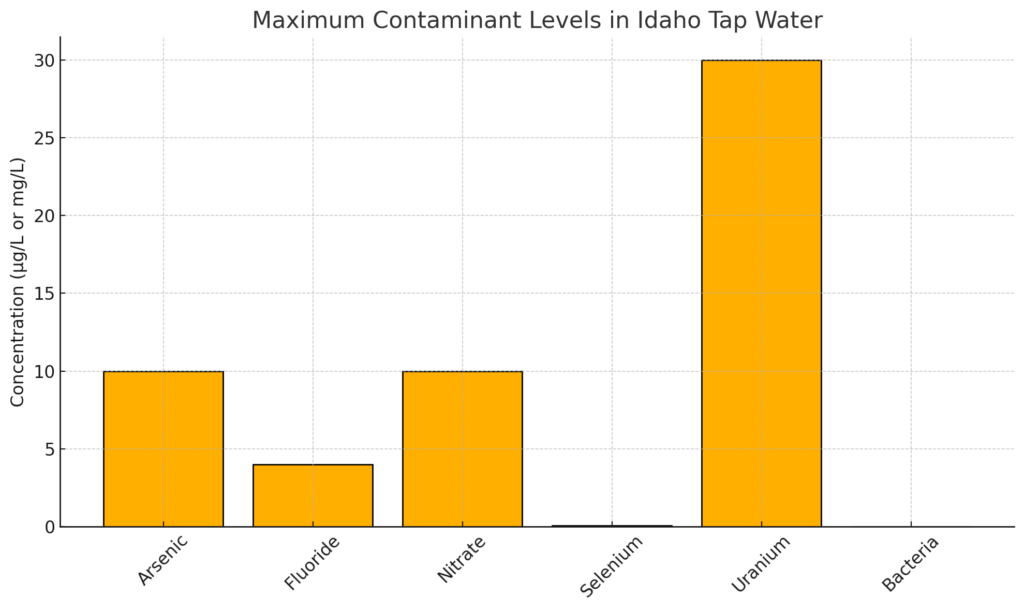
The table below shows primary drinking water standards for selected contaminants in Idaho:
| Contaminant | Maximum Contaminant Level (MCL) |
|---|---|
| Arsenic | 10 ug/L |
| Fluoride | 4 mg/L |
| Nitrate | 10 mg/L |
| Selenium | 0.05 mg/L |
| Uranium | 30 ug/L |
| Bacteria | Zero presence |
Understanding the contaminants in Idaho’s tap water and the regulations protecting public health is key. Residents can make informed decisions about their drinking water and take steps to ensure its safety.
Idaho’s Water Sources and Treatment Processes
Idaho’s drinking water comes from both surface water and groundwater. Despite being 39th in population, the state ranks third in water use. The Eastern Snake Plain Aquifer (ESPA) is a key water source for many communities. This highlights the need for effective water treatment in Idaho.

Surface Water Sources
Idaho’s rivers and lakes are vital for its water supply. The state has over three million acres of irrigated land, ranking fifth in the nation. Idaho also leads in commercial Rainbow Trout production, needing significant freshwater withdrawals.
Groundwater Sources
Groundwater, mainly from the ESPA, is critical for Idaho’s drinking water. The state has invested heavily in water sustainability and research. Recently, Idaho allocated half a billion dollars for water quantity and $10 million to improve the ESPA’s health in 2023.

Water Treatment Methods
Idaho uses various water treatment methods to ensure safe drinking water. These include filtration and disinfection to remove contaminants. The choice of treatment depends on the water source and contaminants.
| Water Source | Key Treatment Methods |
|---|---|
| Surface Water | Coagulation, Flocculation, Sedimentation, Filtration, Disinfection |
| Groundwater | Aeration, Oxidation, Filtration, Disinfection |
Idaho’s population is growing rapidly, making strategic water management essential. Boise State University leads in water research. It has over 100 graduates, 47 faculty members, and $25 million in funded research.
EPA Regulations and Idaho’s Drinking Water Standards
The Environmental Protection Agency (EPA) sets National Primary Drinking Water Standards for about 90 contaminants to protect public health. These epa drinking water standards are adopted and enforced by the Idaho Department of Environmental Quality (DEQ). All public water systems in Idaho must follow these regulations to ensure the safety and quality of drinking water.
The National Primary Drinking Water Standards establish maximum contaminant levels (MCLs) for substances like microorganisms, disinfectants, and chemicals. These standards are legally enforceable and apply to all public water systems in the United States.
National Primary Drinking Water Standards
The EPA’s National Primary Drinking Water Standards cover a wide range of contaminants, each with its own MCL. Some notable contaminants and their respective MCLs include:
| Contaminant | Maximum Contaminant Level (MCL) |
|---|---|
| Total Coliform | No more than 5% of monthly samples can be positive |
| E. coli | Zero |
| Nitrate | 10 mg/L as nitrogen |
| Lead | 0.015 mg/L (action level) |
| Copper | 1.3 mg/L (action level) |
Idaho’s Adoption and Enforcement of EPA Standards
The Idaho DEQ is responsible for implementing and enforcing the epa drinking water standards throughout the state. Public water systems in Idaho must regularly monitor and test their water supply to ensure compliance with these standards. If a water system fails to meet the MCLs, it must take corrective actions and notify the public of the violation.
In addition to adopting the federal standards, Idaho may establish its own drinking water regulations that are more stringent than the EPA’s requirements. This allows the state to address specific water quality concerns unique to Idaho’s water sources and protect public health more effectively.
Common Contaminants Found in Idaho’s Tap Water
Idaho’s tap water can contain various contaminants that pose health risks. Common contaminants include arsenic, coliform bacteria, fluoride, lead, and nitrate. These substances can come from natural sources, agricultural runoff, and old infrastructure. Monitoring and treatment are key to ensuring safe drinking water.
Arsenic, a naturally occurring element, is a major concern in Idaho’s water. Exposure to arsenic in water can cause skin problems, circulatory issues, and increase cancer risk. Lead, another contaminant, can leach from old pipes and fixtures. It can cause developmental delays and learning difficulties in children.
The table below summarizes common contaminants in Idaho’s tap water and their health effects:
| Contaminant | Sources | Potential Health Effects |
|---|---|---|
| Arsenic | Natural deposits, industrial waste | Skin problems, circulatory issues, cancer |
| Coliform bacteria | Sewage, animal waste | Gastrointestinal illness |
| Fluoride | Natural deposits, water treatment additives | Dental fluorosis, skeletal fluorosis (in high doses) |
| Lead | Corroded pipes, plumbing fixtures | Developmental delays, learning difficulties, kidney problems |
| Nitrate | Fertilizers, septic tanks, animal waste | Methemoglobinemia (blue baby syndrome) |
To reduce contaminants in drinking water, regular monitoring and effective treatment are vital. Water utilities in Idaho must follow EPA regulations and state standards. This ensures the safety of tap water for residents. By staying informed and taking action, Idaho residents can protect themselves and their families from these contaminants.
Arsenic in Idaho’s Drinking Water
Arsenic, a naturally occurring element, is found in Idaho’s drinking water, mainly in certain counties. It comes from natural rock formations that dissolve arsenic, contaminating groundwater. The EPA sets the drinking water standard for arsenic at 10 parts per billion (ppb). Yet, southwestern Idaho counties, including Elmore, Gem, Owyhee, and Washington, along with Kootenai and Jefferson, have higher concentrations.
Arsenic Sources and Levels in Idaho
In Idaho, arsenic levels in drinking water are higher in western states than the rest of the U.S. Some areas have levels above the 10 ppb standard. The Idaho Department of Water Resources data shows that while many areas are within the standard, some have significantly higher levels. About 90% of industrial arsenic in the U.S. is used as a wood preservative.
Health Impacts of Arsenic Exposure
Long-term exposure to arsenic can lead to various health issues, including cancer. It is linked to over 30 adverse health effects, such as cardiovascular disease, diabetes, and skin changes. Even low levels of arsenic can cause health problems over time. Acute toxicity, on the other hand, occurs at very high doses, such as 60,000 micrograms, which can be lethal. The main concern is long-term exposure, not short-term consumption.
Arsenic Regulation and Monitoring
Public water systems must monitor and treat water to keep arsenic levels below 10 ppb. All community water systems in Idaho must report arsenic levels over 5 ppb in their annual Consumer Confidence Report to the Department of Environmental Quality (DEQ). Testing frequency for arsenic is typically every 3-5 years. Private well owners are responsible for maintaining their well and ensuring water safety through periodic testing, as ground water quality at privately owned wells is not regulated by the State of Idaho.
| Contaminant | Primary Drinking Water Standard |
|---|---|
| Arsenic | 10 µg/L |
| Fluoride | 4 mg/L |
| Nitrate | 10 mg/L |
| Selenium | 0.05 mg/L |
| Uranium | 30 µg/L |
| Bacteria | ZERO |
Coliform Bacteria in Idaho’s Tap Water
Coliform bacteria, including E. coli, act as indicators of possible contamination in Idaho’s drinking water. Not all coliform bacteria are harmful, but their presence suggests other disease-causing organisms might be present. Regular monitoring and testing for these bacteria ensure the tap water’s safety for Idaho residents.
Types of Coliform Bacteria
Idaho’s water systems test for two main types of coliform bacteria:
- Total coliform bacteria: This group includes various bacteria found in the environment, such as soil, water, and animal digestive tracts. The presence of total coliform bacteria in drinking water indicates possible contamination and the need for further testing.
- E. coli: A subset of total coliform bacteria, E. coli is a specific indicator of fecal contamination. If E. coli is detected in drinking water, it suggests contamination with human or animal waste, posing a serious health risk.
Responding to Coliform Detection
When coliform bacteria are detected in Idaho’s tap water, water systems must take immediate action to protect public health. The response typically involves the following steps:
- Investigation: Water system operators must investigate the source of contamination and identify any causes, such as a break in the distribution system or a failure in the treatment process.
- Additional sampling: More water samples are collected and tested to confirm the initial results and determine the extent of the contamination.
- Corrective actions: Water systems must take steps to eliminate the contamination, which may include disinfecting the water, flushing the distribution system, or making necessary repairs.
- Public notification: If the contamination poses a significant health risk, water systems are required to issue public notifications to alert users and provide guidance on taking precautions, such as boiling water before consumption.
The following table outlines the total coliform limits for different classes of recycled water in Idaho:
| Recycled Water Class | 7-day Median Limit (MPN/100 mL) | Single Sample Maximum (MPN/100 mL) |
|---|---|---|
| Class A | ≤2.2 | ≤23 |
| Class B | ≤2.2 | ≤23 |
| Class C | ≤23 (5-day median) | ≤230 |
By adhering to these limits and promptly responding to any coliform detections, Idaho’s water systems work to maintain the safety and quality of tap water for residents throughout the state.
Fluoride Levels in Idaho’s Drinking Water
Fluoride, a naturally occurring mineral, is found in Idaho’s drinking water. It plays a key role in dental health. While it helps prevent tooth decay, it’s important to keep levels optimal to avoid adverse effects. In Idaho, testing fluoride tap water is essential for ensuring safe drinking water.
The Environmental Protection Agency (EPA) has guidelines for fluoride levels in drinking water. The optimal fluoride level is 0.7 mg/L, which reduces tooth decay by 29% in children aged 4 to 17. Towns with fluoridated water see tooth decay rates 45% lower than those without.
Fluoride Regulation and Recommended Levels
Idaho follows the EPA’s fluoride standards. The state’s maximum contaminant level (MCL) for fluoride is 4 mg/L, the highest allowed. Idaho also has a secondary standard of 2 mg/L, a non-enforceable guideline for taste and odor.
No public water systems in Idaho, except for the Mountain Home Air Force Base, add fluoride to reach optimal levels. Most Idaho residents rely on naturally occurring fluoride in their water.
Testing for Fluoride in Tap Water
Regular testing is key to monitor fluoride levels in Idaho water and ensure compliance. Water utilities in Idaho must test for fluoride and report to the state’s Department of Environmental Quality. Tests are conducted at treatment plants and throughout the system to ensure fluoride levels are consistent.
Residents concerned about fluoride levels can have their water tested by certified labs. Home water testing kits for fluoride are available, but professional testing is recommended for accurate results.
| Contaminant | Idaho MCL (mg/L) | EPA MCL (mg/L) |
|---|---|---|
| Fluoride | 4.0 | 4.0 |
While fluoride is beneficial for dental health, excessive levels can cause dental fluorosis. This condition leads to tooth discoloration and pitting. By monitoring fluoride levels and keeping them within the recommended range, Idaho ensures its residents benefit from fluoride while minimizing risks.

Lead Contamination in Idaho’s Tap Water
Lead contamination in drinking water poses a significant risk to Idaho residents. Public water systems must monitor and control lead levels. Yet, exposure can occur through the corrosion of plumbing materials containing lead. It’s vital for residents to understand the sources of lead in their tap water and take measures to reduce exposure.
Sources of Lead in Drinking Water
The main source of lead contamination in Idaho water is the corrosion of older plumbing materials. This includes lead pipes, fixtures, and solder. Water with high acidity or low mineral content can cause lead to leach into the water supply. Homes built before 1986 are more likely to have lead-based plumbing, increasing the risk of lead exposure.
Health Effects of Lead Exposure
Lead exposure can have severe health consequences, affecting young children and pregnant women the most. Lead can accumulate in the body over time, leading to various adverse effects. These include developmental delays, increased risk of ADHD, kidney damage, and reproductive issues in adults, as well as cardiovascular problems.
In infants, whose diet consists mostly of liquids made with lead-contaminated water, lead exposure can be as high as 60%. This highlights the critical need for testing and ensuring safe drinking water for this vulnerable population.
Reducing Lead Exposure from Tap Water
To minimize the risk of lead exposure from tap water, Idaho residents can take several steps:
- Flush pipes by running cold water for 30 seconds to 2 minutes before drinking or cooking, if the water has been sitting in the pipes for several hours.
- Use only cold water for drinking, cooking, and preparing baby formula, as hot water is more likely to contain higher levels of lead.
- Have your water tested for lead by a certified laboratory, if you live in an older home or suspect your plumbing may contain lead.
- Consider installing a water filtration system certified to remove lead, such as reverse osmosis or activated carbon filters.
Public water systems in Idaho must monitor and control lead levels according to the Lead and Copper Rule. If lead concentrations exceed 15 parts per billion, water systems must take steps to reduce lead levels and inform the public. By working together and staying informed, Idaho residents can ensure safe and lead-free tap water for their communities.
Nitrate Contamination in Idaho’s Drinking Water
Nitrate contamination in Idaho’s water is a pressing concern, with about 20% of the state’s drinking water sources impacted. The main sources include septic systems, animal waste, nitrogen-based fertilizers, and natural deposits. High nitrate levels can lead to severe health issues, mainly in infants and young children.
The EPA has set a Maximum Contaminant Level (MCL) for nitrate at 10 mg/L. Public water systems must regularly monitor nitrate levels. Those with levels over 5 mg/L are subject to quarterly checks. Systems exceeding the MCL must treat the water to ensure public health.
In Idaho, rural areas face higher nitrate contamination due to agricultural runoff, with levels sometimes over 20 mg/L. The Magic Valley region is severely impacted, with nearly 50% of wells showing nitrate levels above safe thresholds. Some private wells in Idaho have nitrate levels up to 40 mg/L, posing significant health risks.
| Region | Percentage of Affected Wells | Average Nitrate Concentration (mg/L) |
|---|---|---|
| Magic Valley | 50% | 12 |
| Rural Areas (Statewide) | – | 20+ |
| Private Wells (Statewide) | – | Up to 40 |
Nitrate contamination is linked to methemoglobinemia, or "blue baby syndrome," in infants under six months. The Idaho Department of Environmental Quality has seen a 15% rise in reported nitrate contamination cases in the last five years.
Idaho has implemented efforts to reduce nitrate levels, leading to a 25% decrease in some water systems. Private well owners should test for nitrate annually. A survey found that about 30% of residents in affected areas are unaware of their drinking water’s nitrate levels. This highlights the need for increased awareness and education on this critical issue.

Is Tap Water in Idaho Safe to Drink?
The safety of Idaho’s tap water is a critical concern for residents and health officials. Public water systems in Idaho are regulated and monitored to meet safety standards. Yet, contaminants can be present. From 2021 to 2023, various contaminants were found in Idaho’s tap water, with some exceeding health guidelines.
The Environmental Working Group (EWG) found contaminants that exceeded health guidelines, posing health risks. These included Perfluoroalkyl substances (PFAS) like Perfluorohexanoic Acid (PFHxA) and Perfluoropentanoic acid (PFPeA). Yet, many contaminants were below health guideline levels during the same period.
The Environmental Protection Agency (EPA) has set standards for about 90 contaminants and health advisories for over 100. For instance, the arsenic standard is 10 parts per billion (ppb). Arsenic exposure can lead to over 30 adverse health effects. In Idaho, arsenic levels are highest in Elmore, Gem, Owyhee, Washington, Kootenai, and Jefferson counties.
Idaho also monitors coliform bacteria, lead, fluoride, and nitrate in tap water. The presence of coliform bacteria suggests contamination. Public notification, like boil advisories, must be issued within 24 hours if fecal coliform or E. coli is found. Lead exposure from drinking water can be significant for young children and infants.
Public water systems in Idaho strive to provide safe drinking water. Private well owners must test and maintain their water quality. It’s essential for Idaho residents to stay informed about their local water quality. By using filtering technologies and staying vigilant, Idahoans can trust their tap water.
Monitoring and Reporting of Idaho’s Drinking Water Quality
Idaho prioritizes the safety and quality of its drinking water. Public water systems must regularly monitor and report their water quality. They follow guidelines from the Idaho Department of Environmental Quality (DEQ).
The idaho water quality monitoring rules differ based on contaminant type and system size. Larger systems test more often, while smaller ones have less frequent schedules. Common tests include for coliform bacteria, lead, nitrates, and chemical pollutants.
Water System Monitoring Requirements
Idaho’s water systems adhere to strict testing schedules. The frequency for each contaminant depends on several factors:
- Population served by the water system
- Source of the water (surface water or groundwater)
- Previous monitoring results and compliance history
For instance, surface water systems test for turbidity daily. Groundwater systems might only test for nitrates annually.
Consumer Confidence Reports
Water providers in Idaho also inform customers about their drinking water quality. They publish consumer confidence reports idaho annually. These reports detail the system’s performance and any contaminants found.
These reports include:
- Source of the drinking water
- Detected contaminants and their levels
- Potential health effects of any contaminants that exceed regulatory limits
- Actions taken to address water quality issues
Consumer confidence reports are mailed to customers or available online. This ensures Idaho residents can easily access vital information about their tap water safety.
Actions for Ensuring Safe Tap Water in Idaho
To ensure Idaho residents have safe drinking water, public water systems must take proactive steps. They need to implement effective water treatment methods and conduct regular testing and maintenance. This is essential for maintaining water quality.
Water Treatment Methods for Contaminant Removal
In Idaho, water treatment facilities use various water treatment methods to remove contaminants. This ensures tap water is safe for consumption. Common methods include filtration, disinfection, and corrosion control.
- Filtration: Removes particles, sediment, and microorganisms from water
- Disinfection: Eliminates harmful bacteria and viruses using chlorine or other disinfectants
- Corrosion control: Reduces lead and copper leaching from pipes by adjusting water chemistry
Reverse osmosis filtration is highly effective in removing a wide range of contaminants. The City of Coeur d’Alene notes that reverse osmosis systems efficiently eliminate most contaminants in their water supply.
Regular Testing and Maintenance of Water Systems
Regular water system maintenance is vital for identifying and addressing issues promptly. Public water systems in Idaho must follow strict testing schedules. This ensures water quality meets EPA and Idaho DEQ regulations.
| Contaminant | Legal Limit (MCL) | EWG Standard | Coeur d’Alene Levels |
|---|---|---|---|
| Arsenic | 10 ppb | 0.004 ppb | 5.95 ppb |
| Chromium (hexavalent) | No legal limit | 0.02 ppb | 0.167 ppb |
| Nitrate | 10 ppm | 0.14 ppm | 0.852 ppm |
| Radium, combined (-226 & -228) | 5 pCi/L | 0.05 pCi/L | 1.13 pCi/L |
The table shows that while Coeur d’Alene’s water meets legal limits, some contaminants exceed EWG standards. Regular testing helps water systems monitor these levels. It allows them to take necessary actions to protect public health.
What Idaho Residents Can Do to Ensure Safe Drinking Water
Idaho residents must take proactive steps to ensure their drinking water is safe and of high quality. This is true whether you get your water from a private well or a public system. There are several actions you can take to protect your health and that of your family.

Testing Private Well Water
For those relying on private wells, regular testing is essential. The Idaho Department of Environmental Quality advises testing private well water annually for harmful contaminants like bacteria, nitrates, and arsenic. These substances can be dangerous if not monitored. Here are some testing guidelines to follow:
| Contaminant | Testing Frequency | Maximum Contaminant Level (MCL) |
|---|---|---|
| Bacteria (Total Coliform) | Annually | 0 |
| Nitrates | Annually | 10 ppm |
| Arsenic | Every 3-5 years | 0.010 ppm |
Using Home Water Treatment Systems
Even with regular testing, your water might contain contaminants above safe levels. In such cases, home water treatment systems can be a viable solution. These systems include water softeners, reverse osmosis units, and activated carbon filters. It’s important to choose a system certified by NSF International or the Water Quality Association.
Staying Informed About Local Water Quality
Whether you have a private well or rely on a public system, knowing your local water quality is key. Public systems must provide annual Consumer Confidence Reports (CCRs) detailing contaminant levels. Take the time to review these reports and reach out to your provider if you have concerns.
By testing private well water regularly, investing in certified home water treatment systems when needed, and staying informed about local water quality, Idaho residents can ensure their drinking water is safe. Clean, safe water is not just a luxury; it’s a fundamental right and essential for a healthy life.
Resources for Idaho Residents Regarding Tap Water Safety
Idaho residents looking for tap water safety information have several reliable sources at their disposal. The Idaho Department of Environmental Quality (DEQ) offers a detailed Drinking Water Program website. It provides insights into water quality, regulations, and testing requirements. This resource helps residents understand contaminants like nitrates, arsenic, selenium, and uranium in their local water supply.
The Environmental Protection Agency (EPA) also offers valuable assistance. They have a Safe Drinking Water Hotline and website. These provide information on contaminants, their health effects, and water treatment options. This guidance helps Idaho residents make informed decisions about their drinking water safety.
For localized information, residents can reach out to their local health departments and water providers. These entities offer specific details on water quality in their area. They also provide information on ongoing testing and remediation efforts. This is essential for those relying on private wells, as regular testing and maintenance are critical for safe drinking water.
| Resource | Information Provided |
|---|---|
| Idaho DEQ Drinking Water Program | Water quality, regulations, testing requirements, contaminants |
| EPA Safe Drinking Water Hotline and Website | Contaminants, health effects, water treatment options |
| Local Health Departments | Area-specific water quality information, testing, remediation efforts |
| Water Providers | Local water quality data, treatment methods, compliance |
By utilizing these idaho tap water safety resources, residents can stay informed and proactive. The idaho deq drinking water program is a key resource. It offers up-to-date information and guidance on maintaining clean, healthy water for Idaho communities.
The Future of Tap Water Safety in Idaho
As Idaho expands, ensuring tap water safety is a critical focus. Public water systems, regulators, and residents all play key roles. To improve water quality, Idaho must invest in infrastructure, protect source waters, and adapt to new contaminants and regulations. Despite a low fluoridation rate of 34.37%, vigilance against other contaminants is essential.
Chloronitramide anion, found in chloramine-treated water nationwide, is a concern. Research on its health effects may take a decade. Yet, proactive steps can be taken to reduce risks and protect Idaho’s tap water.
Idaho residents can contribute to better water safety. Stay informed about local water quality, test private wells, and use home treatment systems when needed. Collaboration between public systems, regulators, and residents is vital. Together, we can ensure clean, safe tap water for future generations.
FAQ
Is tap water in Idaho generally safe to drink?
Yes, tap water in Idaho is generally safe to drink. Public water systems are regulated and monitored to ensure compliance with safety standards. Yet, contaminants can be present. Private well owners are responsible for testing and maintaining their water quality.
What are the common contaminants found in Idaho’s tap water?
Common contaminants in Idaho’s tap water include arsenic, coliform bacteria, fluoride, lead, and nitrate. These contaminants can enter the water supply through natural sources, agricultural runoff, and aging infrastructure.
How can I ensure my private well water is safe to drink?
Private well owners should have their water tested annually for contaminants like bacteria, nitrate, and arsenic. If necessary, certified home water treatment systems can be used to remove contaminants and ensure safe drinking water.
What should I do if lead is detected in my tap water?
To reduce lead exposure from tap water, residents should flush pipes before drinking and consume cold water only. They should also have their water tested. If lead levels exceed the EPA’s action level, consider using a certified water filter or alternative water sources until the issue is resolved.
How can I find out more information about my local water quality?
Residents served by public water systems can access Consumer Confidence Reports. These reports provide information on water quality and any violations. The Idaho DEQ’s Drinking Water Program website and local health departments also offer resources and guidance specific to your area.
What is being done to ensure the future of tap water safety in Idaho?
Ensuring the future of tap water safety in Idaho requires ongoing efforts from public water systems, regulators, and residents. This includes investing in infrastructure upgrades and implementing source water protection measures. Adapting to emerging contaminants and changing regulations is also essential. Continued monitoring, research, and public education are key to maintaining and improving water quality in the state.