

Ammonia in Drinking Water
A technical paper by Olympian Water Testing specialists
Ammonia in Water
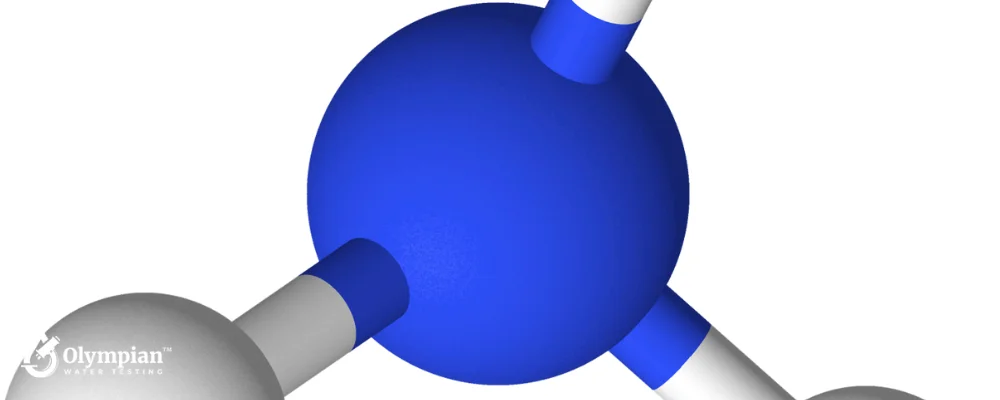
Ammonia is a nitrogen molecule bound to three hydrogen molecules. Ammonia and its constituents are produced by the breakdown of proteins, manure and urine and other nitrogen-based products. Ammonia gas is what makes the smell of dirty diapers and pails so sharply unpleasant and it’s used in cages for birds, chickens and other animals [1]. Ammonia is a colourless gas, and it has a very pungent, distinct odour. Ammonia gasses when it is exposed to air. So, it’s typically a liquid [1]. : Human/anthropogenic processes are the biggest producers of ammonia, a critical nitrogen fertilizer for plants and livestock. Ammonia contamination of water can be very bad for your health – it causes cancer with its nitrate ion, toxins to your organs [1, 2].
This article will teach you more about ammonia and its sulfates, water contamination, the health effects of it, and how to avoid it.
How does ammonia get into the environment?

Animal and Plants
Plants and animals who die exude ammonia into the air. In animals’ guts, there are bacteria that decompose food to produce ammonia.
Industrial activity
The chemical used to make paints, housecleaners, industrial cleaners is ammonia.
Close to 90 percent of the ammonia is produced by the production of farm-crop and lawn fertiliser [1, 2].
How Ammonia Contaminates Drinking Water

When cleaning products used at home and in the workplace might elute ammonia into water, ammonia-laden sewerage water flows straight into sewer systems where it is filtered. But sometimes the foul water will seep into the soil and end up in the groundwater.
Groundwater, of course, has less than 0.2 mg of ammonia per litre of water [2]. Greater quantities of ammonia are naturally present in the following places.
Surface water: Water from lakes, rivers, springs, dams can contain more than 12mg of ammonia per litre of water. And if surface water is full of chloramines, then the ammonia level is certainly high.
When it rains a lot, the sewer lines and septic tanks can rupture and expel the waste to the surface, contaminating drinking water with ammonia.
Geogenic processes like volcanic eruptions release a lot of ammonia, and when the rain comes, the ammonia is pumped into the earth.
Ammonia Levels Recommended for Drinkable Water Amphibious levels are for reference only.
According to the EPA, there’s no right or wrong way to measure optimal ammonia levels in drinking water. But the National Academy of Science recommends 0.5-0.5mg/l for the ammonia element in the water as the MCL [3]. The more ammonia that is in the water, the more severe the health effects likely are.
Health Effects of Drinking Ammonia-Contaminated Water

Ammonia contains a nitrate ion with three hydroxyl ions, which contributes to nitroso compounds that might be cancer-causing. Ammonia toxicity results when the amount of ammonia in the blood is more than the liver can remove, either because there is too much of it produced (in congenital hyperammonemia) or because there is not enough to be removed (in liver cirrhosis) [4]. Ammonia enters your body like this [5]:
Consuming hygienic ammonia gas or liquid ammonia vapor to breath.
Consuming beverages containing ammonia
Hydraulic ammonia gas touching the skin or eyes.
Confusion, dizziness, throat and nose swelling, nausea, vomiting, fainting, hock, nausea, coughing and wheezing, chest pain are short-term health effects of ammonia. If consumed in excess of 1 mg/L of water for long time, internal organs and cancers can result [6]. Low levels of ammonia in water especially poison babies by inducing their vomiting.
The blue baby syndrome is methemoglobinemia where the nitrites attach to the hemoglobin so that it cannot transport oxygen and causes cyanosis (blueness of the skin). When untreated, they cause coma and death [7, 8]. Apart from water, it is also an inherited syndrome in which babies have a lot of nitrate-reducing bacteria in their guts and a very limited ability to convert methemoglobin into haemoglobin. Hence they will probably have "blue baby syndrome." [8]. There are reports of blue baby syndromes following intake of baby formula mixed with water drawn from private wells containing 22.9 mg/L and 27.4 mg/L, respectively [7].
Ammonia in contaminated drinking water raises the nitrosos. Nitrates in your city drinking water fluctuate based on the treatment process. Normal chlorination and the chlorination water treatment process impose different amounts of nitrates on the water. People drinking ammonia-containing water can be poisoned if they get nitrates in the ammonia, which are oxidised in the stomach to become nitrites. These nitrites, when mixed with the amides and amines, in the presence of stomach acid, create carcinogenic N-nitrosos [9].
The deeper they go in the water, the more cancers are likely to be there – Non-Hodgkin’s Lymphoma, stomach, bladder, gastrointestinal cancers.
But there is now evidence to suggest that enough vitamin E, vitamin C, and selenium will prevent cancer since they inhibit nitrite/nitrate reactions with amines to minimize the production of carcinogenic nitrosamines [2, 9].
How would you know that your drinking water is contaminated with ammonia?

The things you need to look for are: Your water has too much ammonia.
Lower pH- your water might be high in ammonia if you have a low pH water because ammonia is acidic. Therefore, if you have any suspicions [10] check your water’s pH regularly.
Low chlorine- If your water has high ammonia concentration, then its chlorine is low (less than 0.1-0.4 mg per liter) [10].
Bacteria– if colonies are on your house filter, you’ve got a lot of ammonia centration. Put a little tap water in a bottle and let it stay for a few days it will smell bad [10].
Bad Odour/Drinking Water-Ammonia makes drinking water smell bad. It’s also moldy because of the excess ammonia [10].
How to Remove Ammonia from Water

Biological Methods- Nitrification Process
Water has nitrogen in it, but only as ammonia or nitrites. Nitrification is done with filters containing selected granular media, biolite. The media is infected with bacteria that convert ammonia into nitrites Nitrification [11]. The water flows through the biolite, sand and granular activated carbon (GAC) filters into a freshwater tank.
Among the requirements to get it to function, the following ones apply:
Small quantities of oxygen
Phosphorus element added for bacterium growth.
Addition of hydrogen carbonates
It should have about 7.5 to 7.5 pH in the water.
Temperatures of 8-10 degrees Celsius
Total lack of residual disinfectant
All of this is available, so the bacteria are easy to convert into nitrites. But do note, you should note the whole seeding takes about 90 days [10]. For this to happen, water must be continuously aerated because the bacteria are aerobic, and need oxygen to efficiently turn ammonia into nitrites. Ammonia that has converted to nitrites can be expelled from the water, and the process works well with large amounts of water.
Oxidation of Water
The water is treated with ozone by microbubbles that are oxidized into ammonia and turned into nitrites [12]. These are the requirements of the process:
pH high- the water needs to be very pH.
Rates of ozone generation would need to be higher, too.
An agent- it can be bromide ions.
That’s the trouble with the oxidation: it’s a pilot process in testing. Nor is it been softened to a simpler process that can be used at the household level.
Other chemicals that can oxidize the water are chloramines and potassium permanganate Note: You will need to remove the nitrites after oxidation in order to contaminate your drinking water. Ion exchange, distillation, nanofilters, carbon nanotubes and nanocellulose are all ways of getting rid of nitrite. These are described in more detail in a different tutorial.
Utilization of Filters

Pozzolana Filters
We’ve found that ammonia comes out of the water with the help of a Pozzolana filter. But the filter must be turned off and soaked in chlorine water.
Biolite Filters
The filter breaks down the ammonia present in the water to nitrites. Then the water can be nitrite treated. They don’t generate any drinking-grade water, but they consume lots of oxygen.
Chlorine Utilization
Infusing water with chlorine is a great way to de-ammoniase water. Organo-chlorines – water-desinfecting compounds – occasionally remove ammonia from the water. Chlorine combined with ammonia gives chloramines that are better for pipelined water since they disinfection is persistent. Water treatment chloramines have been in use since the 1930s, and a fifth of Americans drink chloramine-treated water [13]
The Ion Exchange System
The exchange resin of ion is a resin that contains cations, which are negative and positive ions or anions. The process works because it removes ammonia, chlorine, water softener, nitrate and nitrite, pathogens, and all heavy metals. Moreover, the procedure is very good in killing other inorganic matter.
What are the pros of using the Ion Exchange System

- It offers fast results
- It can be used for small and large tanks
- It is easy to install and use
- It needs little maintenance
- It can be used for short-term and long-term applications
Disadvantages of the system
- It is quite expensive. You need a good amount of money to install the system. However, the system is good, given that it is almost 100% effective.
- The water is clean and safe but plain or lacks taste.
Factors to consider before choosing a water purification method
Water needs
The ion exchange method is the most effective if you need to drink water on a small scale. Some of the methods, such as water oxidation methods, are in a pilot study and may not be viable for your home. Methods such as nitrification are possible for use in water lagoons and pools. Only large and industrial water treatment companies can afford the process.
Point of Use
If you are installing the ion exchange method at your home, it should be compatible with the house space and point of installation.
Maintenance costs
Some methods, such as biolite and pozzolana filters, need low maintenance costs. They only need periodical regeneration and can last for some time.
Conclusion
Periodical water testingand re-testing are essential. It helps you to know the water contaminants and get an effective water purification method. When you are aware and have knowledge of water contamination, it is easy to detect a change in water taste and odor. You also need to know that some methods are not applicable at home. Therefore, you need water experts to help you choose the best method.
The removal of ammonia from the water is not easy. First, you need a method that converts or oxidizes ammonia into nitrites. After oxidation, you need a method to remove nitrites from the water.
Frequently Asked Questions

Does ammonia-contaminated water smell?
Yes, it has a bad taste and irritating odor.
Is there a way of removing ammonia from drinking water?
There is no direct way of removing ammonia from drinking water except through the ion exchange system. The other methods need the oxidation of ammonia which converts it into nitrites and then remove them from the water.
Which water purification method would you recommend for home use?
If you need water for home use, the best water purification method is the ion exchange method. Regardless of its high initial costs, the method removes all the impurities from water and is 99% effective [14].
Why do you need regular water tests?
You need to know the contaminants in your drinking water and the methods you can use to make it safe for you and your family. The effects of contaminated water may cause long-term health issues.
References
- Oregon Department of Human Services: Ammonia. (2000).
- WHO Guidelines for Drinking-water Quality: Ammonia in Drinking-water.
- CDC: Ammonia.
- Padappayil, R.P., Borger, J.: Ammonia Toxicity. In: StatPearls. StatPearls Publishing, Treasure Island (FL) (2022).
- Jurcă, A.D., Jurcă, M.C., Bembea, M., Kozma, K., Budişteanu, M., Gug, C.: Clinical and genetic diversity of congenital hyperammonemia. Rom J Morphol Embryol. 59, 945–948 (2018).
- MN Health: Vulnerability Assessment Parameters Factsheet,
- Knobeloch, L., Salna, B., Hogan, A., Postle, J., Anderson, H.: Blue babies and nitrate-contaminated well water. Environ Health Perspect. 108, 675–678 (2000).
- Piazza, J., Douin, C., Bodson, L., Ghuysen, A., D’Orio, V.: Blue baby syndrome: the source of the truth. Rev Med Liege. 69, 175–179 (2014).
- Wexler, P.: Encyclopedia of toxicology. Elsevier, Oxford, UK (2005).
- Sensorex: How To Treat Ammonia in Water,
- EPA: Nitrification.
- Khuntia, S., Majumder, S.K., Ghosh, P.: Removal of Ammonia from Water by Ozone Microbubbles. Ind. Eng. Chem. Res. 52, 318–326 (2013).
- EPA: Chloramines in Drinking Water,
- Ding, Y., Sartaj, M.: Optimization of ammonia removal by ion-exchange resin using response surface methodology. Int. J. Environ. Sci. Technol. 13, 985–994 (2016).
Share this research on social media
Facebook
Twitter
LinkedIn
See all Research on Ammonia