Understanding Water Hardness and Its Impact on Historical Water Testing and Water Quality
- Published:
- Updated: January 2, 2025
Summary
Water hardness, a key aspect of water quality, has influenced historical water testing and continues to impact water quality today:
- Definition and Measurement: Water hardness is determined by the concentration of dissolved minerals like calcium and magnesium. It’s measured in parts per million (ppm) or milligrams per liter (mg/L) of calcium carbonate equivalent (CaCO3).
- Historical Significance: Early testing methods involved observing soap lathering in water, revealing hardness levels. Mineral-rich waters were prized for their perceived health benefits.
- Impact on Water Quality: Hard water affects taste, odor, and appearance, and can lead to scale buildup. It poses health risks for certain individuals and can hinder water treatment processes like reverse osmosis.

Water is one of the most important natural resources for humans and its quality has direct impacts on public health. Water can vary in quality from temperature to dissolved minerals to contaminants. The first thing we know about water quality is hardness, or the percentage of minerals dissolved in the water, mostly calcium and magnesium.
What is Water Hardness?
Water hardness refers to the concentration of dissolved minerals, primarily calcium and magnesium, in the water. These minerals are essential nutrients for human health and are beneficial in moderate quantities. However, when their concentration is too high, they can cause problems such as the formation of scale in pipes and appliances, decreased efficiency of soap and detergents, and staining of clothes and fixtures.
Water hardness is measured in parts per million (ppm) or milligrams per liter (mg/L) of calcium carbonate equivalent (CaCO3), which is a common mineral used as a reference standard for water hardness. Based on the concentration of minerals in water, it can be classified into the following categories:
- Soft Water: Water with a hardness level below 60 ppm.
- Moderately Hard Water: Water with a hardness level between 60 and 120 ppm.
- Hard Water: Water with a hardness level between 120 and 180 ppm.
- Very Hard Water: Water with a hardness level above 180 ppm.
How is Water Hardness Measured?

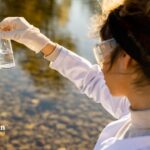
The water hardness is determined by the level of calcium and magnesium ions in the water. Water hardness can be measured by various instruments but the most used instruments are the titration instrument and the atomic absorption spectrophotometer.
Titration: A water sample is diluted with a solution of a known amount of ethylenediaminetetraacetic acid (EDTA), a chelating compound that attaches to calcium and magnesium ions. It is then titrated in a standard solution of a metal ion like zinc, which reacts with the EDTA and excretes the ions of calcium and magnesium. The calcium and magnesium ions are determined by the zinc in the titration.
In the atomic absorption spectrophotometry method, a sample of water is atomised and vaporised by burning it in a flame or graphite furnace. The evaporated product is then passed through a beam of light of a certain wavelength, which is absorbed by the calcium and magnesium ions, and produced a measurable signal. Calculated calcium and magnesium ions concentration is the ratio of signal strength.
Historical Water Testing and Water Quality
Water hardness is old, it was in use for hundreds of years and played a fundamental role in water testing and water quality. The first test of water hardness was invented by Thomas Clark in 1770, with a solution of soap, which measured water’s hardness. He noticed that soap would lather badly in hard water because of insoluble soap scum, and well in soft.
Yet another important historical breakthrough was the knowledge that mineral-rich water was good for us. Natural mineral springs were also attractive as healers in the 18th and 19th centuries, and most people travelled there to enjoy them. It was thought that minerals like calcium and magnesium in the water were healthy, particularly for digestive problems and skin infections.
When 20th-century water treatment and distribution improved, the focus was no longer on mineral water, but on clean water. Hard water in Brooklyn was a health concern, because hard water has the ability to affect the taste, smell and appearance of water and leads to scale accumulation in pipes and plumbing. Hard water also makes soap and detergent less effective, which means more water and cost.
Water softening – the mineral removal from the water that is used in water treatment plants to get rid of these issues. You can soften water with the help of ion exchange resin or lime softening, which can take calcium and magnesium ions and swap them out for sodium or potassium ions. The process causes less hardness and more pure water.
The Impact of Water Hardness on Water Quality
Water hardness is another factor that you should be aware of when getting school water testing services. It causes scaling, degrades soaps and detergents, and affects water taste, smell, and texture. Hard water often tastes metallic or bitter and is hard to smell. As these minerals are dissipated, it can also look cloudy or hazy, which is not good.
Water hardness is not only physical but also can be medically harmful for people with kidney problems or high blood pressure. The calcium and magnesium in hard water make some people develop kidney stones and increase blood pressure.
In addition, water hardness impacts water treatment efficiency such as reverse osmosis (RO) and nanofiltration (NF). They use semi-permeable membranes to flush out minerals, but calcium and magnesium ions in the water can foul and clog membranes. This erodes the system and costs more to maintain, which is why water testing for school is very important for hardness.
The Most Important Facts
Here are the most important facts to take home about water hardness and how it affects historical water testing and water quality:
Water hardness is the amount of dissolved minerals present in water, mostly calcium and magnesium.
Hardness of water is measured in ppm (parts per million) or mg/L (milligrams per liter) of equivalent calcium carbonate (CaCO3).
Previous water hardness tests were done with soap solutions.
Mineral water had become a fad in the 18th and 19th centuries as an alleged healing agent.
The minerals that make water hard are sanitized with water softener.
Hard water alters the taste, smell and appearance of water and deposits scale in pipes and devices.
If you have kidney disease or high blood pressure, hard water can be unhealthy.
Reverse osmosis and nanofiltration cannot work well with hard water.
Water hardness is a key determinant of water quality, and has always been important to the science of water testing and water quality. It’s important to know about water hardness if you want safe and clean drinking water and lower maintenance costs. Water hardness isn’t necessarily harmful to health, but moderate levels of it can be health enhancing. In summary, water hardness is a very important water quality parameter not to be taken for granted, and its concentration should be kept under control to keep our water safe and clean.
Share this on social media:
Facebook
Twitter
LinkedIn

Related Posts