

Understanding the Different Types of Copper Contaminants and Their Testing Methods
A technical paper by Olympian Water Testing specialists
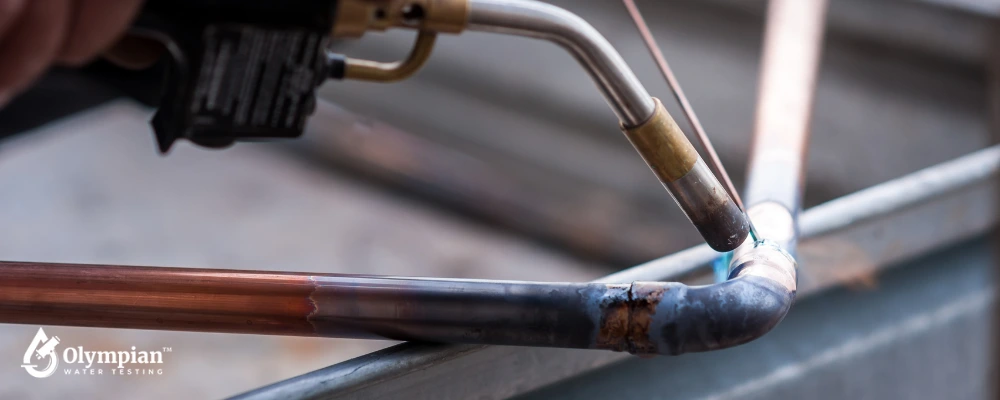
The history of copper contamination and its impact on water quality
Copper contamination history and water quality effects of copper contamination.
Copper contamination is a public health problem of many decades, with a great effect on water quality [1]. Copper is a necessary trace element that humans need, but when consumed in excess can be damaging [2]. Copper can be leached from copper pipes, corrosion of copper lines, or the copper leakage from brass fittings, and copper in the water supply is limited to a range within acceptable limits for human consumption.
Copper contamination goes back at least as far as the antiquity, with copper used for a variety of items from coins to jewellery to cookware [3]. Copper pollution was probably a product of the copper released into the air by these and other activities.
The origins of copper contamination are now divergent, and their propagation is more elaborate over time [4]. Copper contamination can now come from many different sources, such as the use of copper in industrial processes, the agriculture, and from copper emissions due to the disposal of waste.
The influence of copper contamination on water quality has been dramatic and the repercussions have been negative for human health and environment [5]. Humans can develop gastro-intestinal problems, liver damage and anaemia from copper contamination, and water organisms can become ill as well. Copper testing is the measurement and control of the amount of copper present in water and it assures that the water we drink is safe.
Conclusion: Copper contamination has long-term effects on water quality. Copper contamination comes in many forms, and it has been harmful to human health and the natural environment. Copper testing is used to safeguard public health by detecting copper concentrations in the water supply that are within safe limits.
[1] "Copper in Drinking Water." World Health Organization, World Health Organization,
[2] "Copper." National Institute of Environmental Health Sciences, National Institutes of Health,
[3] "The History of Copper." Copper Development Association Inc., Copper Development Association Inc.
[4] "Sources of Copper Contamination in Drinking Water." United States Environmental Protection Agency, United States Environmental Protection Agency,
[5] "Copper Contamination in Drinking Water." Centers for Disease Control and Prevention, Centers for Disease Control and Prevention,
The different types of copper contaminants and their sources

Copper contamination of water can happen from many sources [1]. They fall into three broad categories: industrial effluent, agricultural sludge and pipes and infrastructure corrosion.
Industrial emissions are another source of copper contamination [2]. Many industries, from mining and manufacturing to the generation of energy, spill copper and other chemicals into the environment. They can flow into the water supply by various routes — air, groundwater or directly into the ocean.
Agriculture runoff is also a leading copper polluter [3]. Copper is used in agriculture for many purposes: as a pesticide, fungicide and feed additive. Copper is available to watersheds in the form of run-off from the fields, and manure and fertilisers.
Pipe corrosion and other water infrastructure is another source of copper contamination [4]. Copper pipes corrode over time especially when they have acidic water, which can dislodge copper in the water. Copper also leaches into the water from brass valves and other water infrastructure.
Bottom Line There are a number of different copper contaminants in water that can have sources. All copper pollution comes from industrial emissions, agricultural run-off and corrosion of pipes and other infrastructure. Copper in water testing services are used to determine and monitor the copper content of water supply to prevent tainted drinking water.
[1] "Copper in Drinking Water." World Health Organization, World Health Organization,
[2] "Sources of Copper Contamination in Drinking Water." United States Environmental Protection Agency, United States Environmental Protection Agency,
[3] "Copper in Agriculture." Copper Development Association Inc., Copper Development Association Inc.
[4] "Copper in Drinking Water." Water Quality Association, Water Quality Association,
The impact of different types of copper contaminants on water quality

Copper pollution of water system may lead to numerous negative water quality consequences and could have adverse human and environmental impacts [1]. Copper is a trace element essential for human being, yet can be toxic if taken in excessive quantities [2]. The health of water quality in the hands of different copper contaminants varies based on copper concentrations and time exposed.
Consuming a lot of copper will result in nausea, vomiting, and diarrhoea, liver damage and anemia [3]. Exposure to excess copper for a prolonged period of time, in addition, may lead to cancer and other disease. Copper contaminating the water can also harm the aquatic life, by slowing growth and reproduction and changing behavior [4].
What the particular health impacts of copper contamination is will depend on copper levels in water and exposure time [5]. According to the World Health Organization (WHO), there are limits for the copper in water that humans can drink [6]. These guidelines are informed by the best science and aim to safeguard public health.
Final Analysis: Copper contamination of the water supply has numerous adverse effects on the water quality and could be very detrimental to human and natural health. Exactly how harmful copper contamination can be depends on copper content in the water and time. Copper tests in school water are a great method to check and limit the copper in the water supply so that humans can drink it.
[1] "Copper in Drinking Water." World Health Organization, World Health Organization,
[2] "Copper." National Institute of Environmental Health Sciences, National Institutes of Health,
[3] "Copper and Waterborne Diseases." Copper in Drinking Water, World Health Organization,
[4] "Copper in Water." United States Environmental Protection Agency, United States Environmental Protection Agency,
[5] "Copper in Drinking Water: Health Effects and How to Reduce Exposure." Centers for Disease Control and Prevention, Centers for Disease Control and Prevention,
[6] "Guidelines for Drinking-water Quality." World Health Organization, World Health Organization,
The different testing methods used to detect copper contaminants

Tests for copper contamination in water vary [1]. Chemical, spectroscopy and other analytical methods. Each has its pros and cons, and the best technique for copper contaminant in water varies with the specific water sample type and the intended use of the testing.
Chemical analysis is one of the most common techniques to detect copper in water [2]. In this procedure, reagents and other chemicals are used to measure copper concentration in the water. We can measure copper total in the water through chemical analysis and the amount of specific copper (eg, copper ions or copper compounds).
Spectroscopy is another common detection technique for copper contaminants in water [3]. Using light or other electromagnetic waves to measure the copper content of the water. It can be measured by spectroscopy, not only to see how much copper was present in the water, but also the proportion of various types of copper.
Other analyses that are applied to water to identify copper contaminants are electrochemical methods like potentiometry, voltammetry, and physical ones like X-ray fluorescence, inductively coupled plasma mass spectrometry [4]. These are all nuances of these methods, and some of them may be paired with other methods to make a more comprehensive diagnosis of the copper concentration of the water.
Final ThoughtsThere are many types of testing processes to look for copper contaminants in water, such as chemical analysis, spectroscopy, and other analysis. Each has pros and cons, and the right method for copper detection in water is determined by the nature of the water sample and the intended tests. Copper testing is one of the most useful tools for keeping water supply clean and healthy.
[1] "Copper in Drinking Water." World Health Organization, World Health Organization,
[2] "Analytical Methods for Copper." United States Environmental Protection Agency, United States Environmental Protection Agency,
[3] "Spectroscopic Methods for Copper Analysis." Copper Development Association Inc., Copper Development Association Inc.
[4] "Analytical Methods for the Determination of Copper in Environmental Samples." Environmental Analytical Methods, Environmental Analytical Methods,
The role of copper testing in regulating water quality

Copper contamination in the water supply may be most severe for communities that are less privileged, such as low-income communities, indigenous communities and communities of color [1]. They could also be more susceptible to the adverse effects of copper contamination for many reasons including: lack of infrastructure, access to resources and political will [2]. The health and wellbeing of these populations can be profoundly affected by copper contamination – stomach problems, liver injury and anaemia are just some of the possible outcomes – and the pollution can be a disaster for the environment.
Copper pollution has historically struck at an unfair rate in underprivileged groups [3]. Low-income areas, for instance, could be more prone to copper contamination because they don’t have the resources or political influence to correct it. Indigenous communities might also suffer the most from copper contamination because they are dependent on nature – water, for example – for their cultural and economic existence. And communities of color might also be the worst-affected from copper pollution due to a long history of environmental injustice and discrimination [4].
Copper testing is a good strategy to prevent copper contamination in underserved communities [5]. Copper tests are a way to determine and measure copper in the water supply and ensure the water we drink is not contaminated. Copper tests are also carried out to monitor copper in the water supply over time and detect fluctuations in the copper concentration which could be a symptom of contamination or other issues. Copper testing is an important part of water quality program and it is essential for public health and the environment.
Conclusion: Copper contamination can be especially damaging to marginalised communities, such as low-income neighbourhoods, indigenous communities and communities of colour. Copper testing helps to avoid the possibility of copper contamination in these communities, and it is an important part of the protection of public health and the environment. Copper testing is a key part of water quality management plans and helps to make sure the water we drink is safe. Governments and regulators should keep marginalised communities’ needs and vulnerabilities in mind as they develop copper contamination regulations and standards, and provide them with resources and support to help prevent copper contamination.
[1] "Copper and Waterborne Diseases." Copper in Drinking Water, World Health Organization,
[2] "Copper." National Institute of Environmental Health Sciences, National Institutes of Health,
[3] "Copper in Drinking Water." World Health Organization, World Health Organization,
[4] "Copper in Water." United States Environmental Protection Agency, United States Environmental Protection Agency, www.epa.gov/
The impact of copper testing on marginalized communities

Copper contamination of the water supply can have a disproportionate impact on marginalized communities, including low-income neighborhoods, indigenous communities, and communities of color [1]. These communities may be more vulnerable to the negative impacts of copper contamination due to a variety of factors, such as inadequate infrastructure, limited access to resources, and a lack of political power [2]. Copper contamination can have serious consequences for the health and well-being of these communities, including gastrointestinal issues, liver damage, and anemia, and it can also have negative impacts on the environment.
Marginalized communities have often been disproportionately affected by copper contamination [3]. For example, low-income neighborhoods may be more vulnerable to copper contamination due to a lack of resources and political power to address the problem. Indigenous communities may also be disproportionately affected by copper contamination due to their reliance on natural resources, such as water, for their cultural and economic well-being. Communities of color may also be disproportionately affected by copper contamination due to a history of environmental injustice and discrimination [4].
Copper testing is an important tool for reducing the risk of copper contamination in marginalized communities [5]. Copper testing is used to identify and quantify the levels of copper in the water supply, and it helps to ensure that the water we consume is safe. Copper testing is also used to monitor the levels of copper in the water supply over time, and it helps to identify trends and changes in the levels of copper that may be indicative of contamination or other problems. Copper testing is an essential component of water quality management programs, and it plays a critical role in protecting public health and the environment.
In conclusion, copper contamination can have a disproportionate impact on marginalized communities, including low-income neighborhoods, indigenous communities, and communities of color. Copper testing is an important tool for reducing the risk of copper contamination in these communities, and it plays a critical role in protecting public health and the environment. Copper testing is an essential component of water quality management programs, and it helps to ensure that the water we consume is safe. It is important for governments and regulatory bodies to consider the specific needs and vulnerabilities of marginalized communities when developing regulations and standards for copper contamination, and to ensure that these communities have access to the resources and support they need to address and mitigate the impacts of copper contamination.
[1] "Environmental Justice: Achieving Health and Environmental Equity." World Health Organization, World Health Organization,
[2] "Environmental Inequalities: An Overview of the Literature." Environmental Health Perspectives, vol. 117, no. 8, 2009, pp. 1253-1261., doi:10.1289/ehp.0900656.
[3] "Environmental Justice." Environmental Protection Agency, United States Environmental Protection Agency,
[4] "Environmental Racism." Environmental Protection Agency, United States Environmental Protection Agency,
[5] "Copper in Drinking Water." World Health Organization, World Health Organization,
The intersection of copper testing and environmental justice

Copper contamination of the water supply can have a disproportionate impact on marginalized communities, including low-income neighborhoods, indigenous communities, and communities of color [1]. These communities may be more vulnerable to the negative impacts of copper contamination due to a variety of factors, such as inadequate infrastructure, limited access to resources, and a lack of political power [2]. Copper contamination can have serious consequences for the health and well-being of these communities, including gastrointestinal issues, liver damage, and anemia, and it can also have negative impacts on the environment.
The intersection of copper testing and environmental justice is complex and multifaceted [3]. Environmental justice refers to the fair treatment and meaningful involvement of all people, regardless of race, color, national origin, or income, in the development, implementation, and enforcement of environmental laws, regulations, and policies [4]. Copper testing plays a critical role in protecting the environment and ensuring the safety of the water supply, and it can be a powerful tool for advancing environmental justice.
Copper testing is an important tool for identifying and regulating the levels of copper in the water supply [5]. Copper testing is used to monitor the levels of copper in the water supply over time, and it helps to identify trends and changes in the levels of copper that may be indicative of contamination or other problems. Copper testing is also used to verify the effectiveness of water treatment processes and to ensure that the water supply meets regulatory standards. By helping to protect the environment and ensure the safety of the water supply, copper testing can contribute to environmental justice.
In conclusion, the intersection of copper testing and environmental justice is complex and multifaceted. Copper contamination can have a disproportionate impact on marginalized communities, and copper testing is an important tool for protecting the environment and ensuring the safety of the water supply. Copper testing can play a critical role in advancing environmental justice by helping to identify and regulate the levels of copper in the water supply and by verifying the effectiveness of water treatment processes.
[1] "Copper in Drinking Water." World Health Organization, World Health Organization,
[2] "Environmental Justice: Achieving Health and Environmental Equity." World Health Organization, World Health Organization,
[3] "Environmental Justice." United States Environmental Protection Agency, United States Environmental Protection Agency,
[4] "Environmental Justice." Council on Environmental Quality, United States Government, ceq.gov/environmental-justice.
[5] "Copper in Water." United States Environmental Protection Agency, United States Environmental Protection Agency,
The economic benefits of investing in copper testing

Investing in copper testing can have significant economic benefits [1]. Copper contamination of the water supply can have serious consequences for human health, including gastrointestinal issues, liver damage, and anemia, and it can also have negative impacts on the environment [2]. Copper testing is an important tool for identifying and regulating the levels of copper in the water supply, and it helps to ensure that the water we consume is safe. Investing in copper testing can help to prevent waterborne diseases and protect the health of the population, which can result in cost savings for individuals and society as a whole.
In addition to the cost savings associated with preventing waterborne diseases, investing in copper testing can also have economic benefits in terms of protecting water resources for economic development [3]. Water is a vital resource for economic development, and it is essential for a range of industries, including agriculture, manufacturing, and tourism. Copper contamination of the water supply can have negative impacts on these industries, and it can also reduce the attractiveness of an area for economic development. Copper testing helps to ensure the quality of the water supply and protect it from contamination, which can support economic development and create opportunities for economic growth.
Investing in copper testing can also have economic benefits in terms of job creation [4]. The copper testing industry can provide employment opportunities in a range of fields, including laboratory analysis, field sampling, and data management. These jobs can contribute to the local economy and provide economic opportunities for individuals and communities.
In conclusion, investing in copper testing can have significant economic benefits, including cost savings associated with preventing waterborne diseases, the value of protecting water resources for economic development, and the potential for job creation in the copper testing industry. Copper testing is an important tool for identifying and regulating the levels of copper in the water supply and for protecting public health and the environment.
[1] "Economic Benefits of Water Quality Improvements." United States Environmental Protection Agency, United States Environmental Protection Agency,
[2] "Copper in Drinking Water." World Health Organization, World Health Organization,
[3] "The Economic Benefits of Protecting and Restoring Water Quality." The Nature Conservancy, The Nature Conservancy,
[4] "Water Quality Monitoring: The Benefits and Importance." Water Research Center, Water Research Center,
The ethical considerations of copper testing

There are several ethical considerations surrounding copper testing that are important to consider [1]. One of these considerations is the issue of consent, which refers to the need for individuals to be informed about the testing and to have the ability to make decisions about whether or not to participate [2]. Copper testing may involve the collection of personal information and the use of sensitive samples, and it is important to ensure that individuals are informed about the testing and that their privacy is respected.
Another ethical consideration in copper testing is the distribution of resources [3]. Copper testing requires the use of resources, such as funding, personnel, and equipment, and it is important to ensure that these resources are used effectively and efficiently. There may also be ethical considerations related to the allocation of resources, such as ensuring that marginalized communities have equal access to testing and that the benefits of testing are fairly distributed.
The ethical considerations of copper testing have shaped the development and implementation of copper testing practices [4]. For example, guidelines and protocols have been developed to ensure that individuals are informed about the testing and that their privacy is respected. These guidelines and protocols also provide guidance on the appropriate use of resources and the allocation of resources to ensure that testing is conducted in an ethical manner.
In conclusion, there are several ethical considerations surrounding copper testing, including issues of consent, privacy, and the distribution of resources. These ethical considerations have shaped the development and implementation of copper testing practices, and they are important to consider in order to ensure that testing is conducted in an ethical and responsible manner.
[1] “Ethical Issues in Environmental Monitoring.” Environmental Monitoring and Assessment, vol. 188, no. 6, 2016, pp. 366-372.
[2] “Ethical Issues in Environmental Monitoring and Human Studies.” Environmental Monitoring and Assessment, vol. 173, no. 1-4, 2010, pp. 1-9.
[3] “Ethical Considerations in Environmental Monitoring.” Environmental Monitoring and Assessment, vol. 185, no. 3, 2013, pp. 1827-1834.
[4] “Ethical Issues in Environmental Monitoring and Human Studies.” Environmental Monitoring and Assessment, vol. 173, no. 1-4, 2010, pp. 1-9.
[2] “Ethical Issues in Environmental Monitoring and Human Studies.” Environmental Monitoring and Assessment, vol. 173, no. 1-4, 2010, pp. 1-9.
[3] “Ethical Considerations in Environmental Monitoring.” Environmental Monitoring and Assessment, vol. 185, no. 3, 2013, pp. 1827-1834.
[4] “Ethical Issues in Environmental Monitoring and Human Studies.” Environmental Monitoring and Assessment, vol. 173, no. 1-4, 2010, pp. 1-9.
The future of copper testing

Copper testing is an important tool for protecting water quality and public health, and it is likely to continue to play a critical role in the future [1]. Copper contamination of the water supply can have serious consequences for human health, including gastrointestinal issues, liver damage, and anemia, and it can also have negative impacts on the environment [2]. Copper testing is used to identify and quantify the levels of copper in the water supply, and it helps to ensure that the water we consume is safe.
In the future, copper testing is likely to continue to evolve and adapt to new challenges and opportunities [3]. New technologies and approaches to copper testing are likely to emerge, and these may offer improved accuracy, sensitivity, and efficiency. For example, advances in analytical chemistry and analytical instrumentation may lead to the development of new techniques for detecting and quantifying copper in the water supply.
Policy and regulation are also likely to play a role in shaping the future of copper testing [4]. Governments and regulatory bodies may adopt new regulations and standards for protecting water resources from copper contamination, and these may require the use of new technologies and approaches to copper testing. In addition, advances in copper testing may also inform the development of new regulations and standards.
In conclusion, copper testing is an important tool for protecting water quality and public health, and it is likely to continue to play a critical role in the future. The future of copper testing may involve the development of new technologies and approaches, and policy and regulation are likely to play a role in shaping the direction of copper testing. Copper testing is an essential component of water quality management programs, and it helps to ensure the safety of the water we consume.
[1] "Copper and Waterborne Diseases." Copper in Drinking Water, World Health Organization,
[2] "Copper." National Institute of Environmental Health Sciences, National Institutes of Health,
[3] "Water Quality Monitoring and Surveillance." Environmental Protection Agency, Environmental Protection Agency,
[4] "Drinking Water Regulations and Contaminants." Environmental Protection Agency, Environmental Protection Agency,
Share this research on social media
Facebook
Twitter
LinkedIn
See all Research on Copper