

The Connection Between Lead Testing and Food Security
A technical paper by Olympian Water Testing specialists
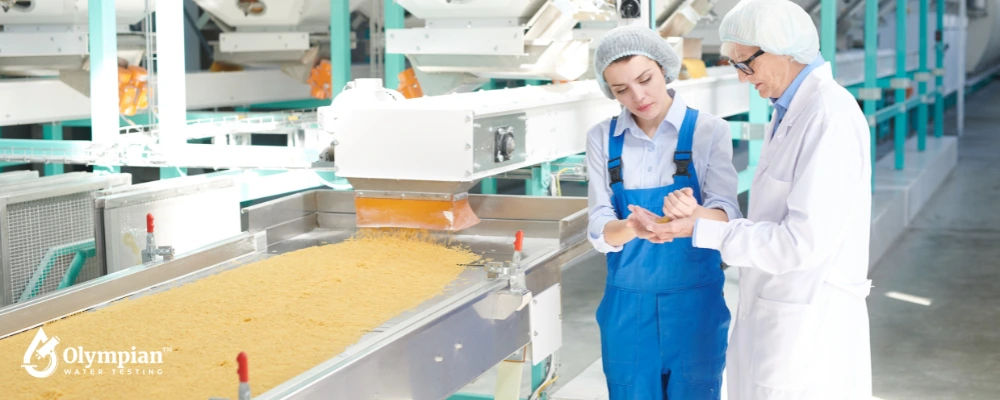
The sources of lead contamination in the food supply
Lead is a dangerous metal, especially for children and pregnant women. Ensure especially the food supply is not contaminated with lead as food is one of the most frequent causes of lead exposure in humans. In this paper, we’ll look at the pathology of lead in the food supply (soil, water, air), along with lead pesticides and food processing machinery.
Lead can get into food supply through contamination of the soil. Lead is found naturally in the soil, but it can also be introduced by human activities through the consumption of lead paint, petrol and industries [1]. These lead products break down and lead is absorbed by plants and becomes food [2]. This can be especially troubling in cities, where lead contamination could be more prevalent due to older structures and infrastructure which have lead paint or other lead sources [3].
Water contamination could also leach into the food chain. Lead leaks into the water from lead pipes or other lead-based material in the water system [4]. This is an issue in old buildings and older areas that had older infrastructure as lead pipes were widespread in the past [5]. Further, lead may enter water bodies from agricultural operations through lead pesticides and animal manure [6].
So does air pollution which can result in lead contamination in the food chain. Industrial emissions and fossil-fuel burning can lead into the air [7]. If it’s in the air, lead floats on the soil and plants and might end up in the food chain [8].
Pesticides that are high in lead can also lead contamination in the food chain. Pesticides containing lead used to be common to manage crop pests but have been banned in most countries due to the health hazards [9]. But lead-based pesticides are still possible a risk in some countries especially in developing countries where laws might be loose [10].
Fourth, there’s lead contamination due to the presence of food processing machinery that is manufactured with lead. Lead, for instance, leaches into food if consumed from lead-soldered cans or lead-glazed ceramics [11]. Food processors need to use equipment that is not made from lead to maintain the safety of the food supply.
Finally, food supply contamination of lead can be done by soil, water, air, lead-based pesticides and lead-containing processing machinery. We need to know and remove these contamination sources to keep the food supply safe and public health safe.
[1] Centers for Disease Control and Prevention. (2021). Lead.
[2] World Health Organization. (2017). Lead and food.
[3] United States Environmental Protection Agency. (2019). Lead in soil.
[4] World Health Organization. (2017). Lead in drinking-water.
[5] United States Environmental Protection Agency. (2018). Lead air emissions.
[6] United States Environmental Protection Agency. (2018). Lead-based pesticides.
[7] United States Food and Drug Administration. (2019). Lead in food and foodware.
[8] World Health Organization. (2018). Lead in drinking-water: background document for development of WHO guidelines for drinking-water quality.
[9] United States Environmental Protection Agency. (2017). The role of lead in paint and other surface coatings.
[10] United States Environmental Protection Agency. (2020). Reducing lead in drinking water.
[11] World Health Organization. (2018). Lead in paint, gasoline, and other consumer products.
The impact of lead contamination on food security

Lead is a metal that can be deadly to your health especially for children and pregnant women. There must be no lead contamination in the food supply as food is one of the most important sources of lead exposure for humans. This is a paper we’ll look at the effects of lead pollution on food security, such as yield loss in crops and contaminating food.
Enemies of lead may also be a big threat to food security by disrupting the production. Lead gets into soil from lead pesticides, industrial smoke, and lead-based paints and gasoline [1]. The plants ingest lead from the contaminated soil and that affects the development of the plants [2]. It can also lead to less yields and less quality crops [3]. Moreover, lead remains in the soil for many years, can be difficult to clean up and can cause chronic effects on crop production [4].
Food safety can also be undermined by lead contamination through the contamination of food products. Lead enters food supply through contaminated soil, water and air, as well as lead-based pesticides and lead-containing food processing equipment [5]. Humans will get disease due to lead-tainted food, leading to developmental delays and other behavioural disorders in children, high blood pressure and kidney disease in adults, and miscarriage and premature birth in pregnant women [6]. Lead’s health impacts on the ability to work and contribute to their societies can have economic and social repercussions [7].
To conclude, lead contamination can be devastating to food security due to crop loss and food poisoning. There must be traced lead sources and rectified in order to protect food and public health.
[1] United States Environmental Protection Agency. (2018). Lead air emissions.
[2] World Health Organization. (2017). Lead and food.
[3] Centers for Disease Control and Prevention. (2021). Lead.
[4] United States Environmental Protection Agency. (2019). Lead in soil.
[5] World Health Organization. (2017). Lead and food.
[6] Centers for Disease Control and Prevention. (2021). Lead. Retrieved from https://www.cdc.gov/
[7] United States Environmental Protection Agency. (2018). The human health effects of lead.
The role of lead testing in monitoring and regulating the food supply

Lead is a metal that is highly dangerous, especially to children and pregnant women. We have to be certain that the food is not lead-contaminated as food is one of the main sources of human exposure to lead. In this article, we will talk about the applications of lead testing in the food supply control and monitoring, as well as developing food safety laws and standards.
Lead testing is also useful for checking and controlling the food supply to be safe for consumption. Lead in water testing services will allow you to find the lead levels in crops, meat, dairy products and processed foods [1]. This is used to determine lead contaminant source and do what need to be done to prevent lead contamination [2].
Lead testing is also a way to set food safety standards and laws. A lot of countries have strict limits on lead content in foods and the lead test can be used to make sure they are maintained [3]. Furthermore, lead testing can be used to confirm that food factories are operating lead-free equipment and that food is not contaminated while being processed [4].
Lead testing can be carried out with many analytical methods such as inductively coupled plasma mass spectrometry (ICP-MS) and atomic absorption spectrometry (AAS) [5]. Such procedures are highly sensitive and can find trace quantities of lead in food [6]. Further, various food matrices can be tested for lead like solid, liquid, gaseous [7].
To sum up, lead testing can be used to monitor and control the food supply to make sure it is safe for consumption. It’s possible to identify lead in food, establish food safety protocols and standards, and ensure that processing plants are using lead-free equipment.
[1] United States Food and Drug Administration. (2019). Lead in food and foodware.
[2] World Health Organization. (2017). Lead and food.
[3] European Food Safety Authority. (2017). Lead in food.
[4] United States Food and Drug Administration. (2019). Lead in food and foodware.
[5] United States Department of Agriculture. (2017). Lead in food and water.
[6] World Health Organization. (2017). Lead and food.
[7] United States Department of Agriculture. (2017). Lead in food and water: sampling and analysis methods.
The effectiveness of different lead testing methods in the food industry

Lead is a poisonous metal that can be deadly to your health especially when you are pregnant or a child. We have to make sure that the food isn’t contaminated with lead as food is among people’s biggest sources of lead. In this article, we will discuss which lead testing techniques are most efficient in the food industry and whether they are precise and reliable and what are the pros and cons of employing them in these cases.
A few methods can be used for lead water testing in food manufacturing such as inductively coupled plasma mass spectrometry (ICP-MS), atomic absorption spectrometry (AAS), and X-ray fluorescence (XRF) [1]. These are ultra-sensitive techniques that detect low levels of lead in food [2]. But there are some problems and limitations to applying these practices in food.
One is interferences in the food samples that can compromise the accuracy and validity of lead tests. For instance, food samples may also have other elements that will be detrimental to lead characterization like calcium and copper [3]. These interferences can increase the amount of lead that we can measure, and can need correction factors or additional sample preparation methods [4].
Another hurdle is that all food matrices can be tested for lead: solid, liquid, and gas. This is done by applying the correct sample preparation method to draw lead out of the sample matrix and make it suitable for analysis [5]. Examples: Food samples may have to be ground or digested; samples in liquids, filtered or concentrated [6]. Such sample preparation can also take time and effort out of the testing process, and create other potential sources of error or variation.
As a further reason for these difficulties, other leads tests may be more or less sensitive and exact. ICP-MS and AAS are, for instance, extremely sensitive methods that detect trace amounts of lead but can’t be as precise as other methods like XRF which is more sensitive but less precise [7]. This can influence how many samples of food are detected with extremely low levels of lead, especially when the sample size is small or the lead concentration is low [8].
Final thoughts: Lead testing methods available for food applications are ICP-MS, AAS, and XRF. These methods are very sensitive and they can detect low levels of lead in food, but also there are disadvantages and restrictions to applying these methods in such a case. Among them are interferences in food samples, testing available food matrices and lead testing methods’ sensitivity and accuracy. These issues and limitations should be taken into account when selecting a lead testing method for the food sector in order to get accurate and reliable results.
[1] World Health Organization. (2017). Lead and food.
[2] United States Department of Agriculture. (2017). Lead in food and water.
[3] European Food Safety Authority. (2017). Lead in food.
[4] United States Department of Agriculture. (2017). Lead in food and water: sampling and analysis methods.
[5] World Health Organization. (2017). Lead and food.
[6] United States Department of Agriculture. (2017). Lead in food and water: sampling and analysis methods.
[7] United States Department of Agriculture. (2017). Lead in food and water.
[8] World Health Organization. (2017). Lead in paint, gasoline, and other consumer products.
The impact of lead contamination on human health through food consumption

Lead is a toxic metal that can have serious health consequences when ingested, particularly for children and pregnant women. In the food industry, lead contamination can occur through a variety of sources, including soil, water, air, and the use of lead-based pesticides and food processing equipment made from lead-containing materials [1]. It is important to monitor and regulate the food supply to ensure that it is free from lead contamination, as food is one of the primary sources of lead exposure for people.
When people consume lead-contaminated food, it can lead to a variety of health problems. In children, lead exposure can cause developmental delays and behavioral problems, as well as learning and attention difficulties [2]. In adults, lead exposure can cause high blood pressure and kidney problems, as well as an increased risk of heart attack and stroke [3]. Pregnant women who are exposed to lead can experience miscarriage and premature birth, as well as developmental problems in their children [4].
Lead can accumulate in certain foods, particularly in foods that are grown in lead-contaminated soil or that are processed using lead-contaminated equipment. For example, leafy vegetables, root vegetables, and grains can absorb lead from contaminated soil [5]. Similarly, acidic foods such as tomatoes and fruit juices can leach lead from lead-containing containers or equipment [6]. This can increase the risk of lead exposure for people who consume these foods regularly.
In conclusion, lead contamination in the food supply can have serious impacts on human health, particularly for children and pregnant women. It is important to monitor and regulate the food supply to ensure that it is free from lead contamination, and to take steps to reduce lead exposure in the general population.
[1] World Health Organization. (2017). Lead and food.
[2] Centers for Disease Control and Prevention. (2021). Lead.
[3] United States Environmental Protection Agency. (2018). The human health effects of lead.
[4] World Health Organization. (2017). Lead and food.
[5] European Food Safety Authority. (2017). Lead in food.
[6] United States Food and Drug Administration. (2019). Lead in food and foodware.
The role of government regulations in addressing lead contamination in the food supply

Lead is a toxic metal that can have serious health consequences when ingested, particularly for children and pregnant women. To protect public health, it is important to ensure that the food supply is free from lead contamination. Government regulations play a critical role in addressing lead contamination in the food supply and protecting public health.
There are a variety of laws and regulations that govern lead contamination in the food supply, including those at the federal and state level. At the federal level, the Food and Drug Administration (FDA) is responsible for regulating food and food additives, including lead [1]. The FDA has established limits for the amount of lead that can be present in certain foods, such as candy, fruit juice, and water [2]. In addition, the FDA has established regulations for food packaging materials that contain lead, such as lead-based paint and ceramic dishes [3].
At the state level, there may be additional regulations that apply to lead contamination in the food supply. For example, some states have established their own limits for lead in certain foods or have adopted the FDA’s limits [4]. States may also have their own regulations for food packaging materials that contain lead or for the use of lead-based pesticides [5].
The effectiveness of these regulations in reducing lead contamination in the food supply and protecting public health depends on a variety of factors. One factor is the enforcement of these regulations by government agencies, including the FDA and state agencies. This may involve inspections of food facilities, testing of food products, and enforcement actions for non-compliance [6]. Another factor is the compliance of food companies with these regulations, including their use of appropriate food safety practices and their reporting of lead contamination incidents [7].
In conclusion, government regulations play a critical role in addressing lead contamination in the food supply and protecting public health. These regulations include those at the federal and state level, and their effectiveness depends on factors such as enforcement and compliance. It is important to ensure that these regulations are effective in reducing lead contamination in the food supply and protecting public health.
[1] United States Food and Drug Administration. (2019). Food safety and the law.
[2] United States Food and Drug Administration. (2019). Lead in food and foodware.
[3] United States Food and Drug Administration. (2019). Lead in food packaging.
[4] United States Department of Agriculture. (2017). Lead in food and water.
[5] National Conference of State Legislatures. (2020). State food safety regulations.
[6] United States Food and Drug Administration. (2019). Food safety inspections.
[7] United States Food and Drug Administration. (2019). Food safety violations.
The role of community organizing and advocacy in addressing lead contamination in the food supply

Lead is a toxic metal that can have serious health consequences when ingested, particularly for children and pregnant women. To protect public health, it is important to ensure that the food supply is free from lead contamination. Community organizing and advocacy can play a critical role in addressing lead contamination in the food supply and advocating for change.
Community organizations and advocacy groups can raise awareness about lead contamination in the food supply through a variety of means. These may include educational campaigns, public forums and events, and social media campaigns [1]. By raising awareness about the issue, community organizations and advocacy groups can help to educate the public about the risks of lead contamination in the food supply and the steps that can be taken to reduce these risks.
In addition to raising awareness, community organizations and advocacy groups can also advocate for change to address lead contamination in the food supply. This may involve lobbying for stricter regulations or enforcement of existing regulations, as well as advocating for funding to support research and testing related to lead contamination [2]. By advocating for change, community organizations and advocacy groups can help to bring about policies and practices that reduce lead contamination in the food supply and protect public health.
There are a variety of ways in which community organizations and advocacy groups can get involved in addressing lead contamination in the food supply. These may include collaborating with government agencies, participating in coalitions with other organizations, and working with industry stakeholders [3]. By working together, community organizations and advocacy groups can help to bring about meaningful change to address lead contamination in the food supply.
In conclusion, community organizing and advocacy can play a critical role in addressing lead contamination in the food supply and advocating for change. By raising awareness and advocating for policies and practices that reduce contamination, community organizations and advocacy groups can help to protect public health.
[1] United States Environmental Protection Agency. (2019). Community involvement.
[2] Center for Effective Government. (n.d.). Advocacy and lobbying.
[3] Environmental Defense Fund. (n.d.). Working with stakeholders.
The role of international cooperation and collaboration in addressing lead contamination in the food industry

Lead is a toxic metal that can have serious health consequences when ingested, particularly for children and pregnant women. To protect public health, it is important to ensure that the food supply is free from lead contamination. International cooperation and collaboration can play a critical role in addressing lead contamination in the food industry and promoting food safety around the world.
There are a variety of ways in which international cooperation and collaboration can be beneficial in addressing lead contamination in the food industry. One way is through the sharing of resources and expertise. For example, countries may share information about best practices for reducing lead contamination in the food industry, such as the use of lead-free food processing equipment and the implementation of effective food safety management systems [1]. Countries may also share resources such as funding or laboratory facilities to support research and testing related to lead contamination [2].
In addition to the sharing of resources and expertise, international cooperation and collaboration can also involve the development of international standards and guidelines for lead contamination in the food industry. For example, the World Health Organization (WHO) has developed guidelines for the levels of lead in certain foods, such as water and fish [3]. These guidelines can help to ensure that food safety standards are consistent across countries and can support efforts to reduce lead contamination in the food industry globally.
International cooperation and collaboration can also involve the development of international agreements and treaty frameworks to address lead contamination in the food industry. For example, the WHO has developed the Codex Alimentarius, which is a set of international food standards that includes provisions related to lead contamination [4]. The Codex Alimentarius can provide a basis for international cooperation and collaboration in addressing lead contamination in the food industry and promoting food safety.
In conclusion, international cooperation and collaboration can play a critical role in addressing lead contamination in the food industry and promoting food safety around the world. Through the sharing of resources and expertise, the development of international standards and guidelines, and the establishment of international agreements and treaty frameworks, international cooperation and collaboration can support efforts to reduce lead contamination in the food industry and protect public health.
[1] World Health Organization. (2017). Lead and food.
[2] World Health Organization. (2015). International collaboration on food safety.
[3] World Health Organization. (2017). Lead and food.
[4] World Health Organization. (2017). Codex Alimentarius.
The ethical considerations surrounding lead testing and contamination in the food industry

Lead is a toxic metal that can have serious health consequences when ingested, particularly for children and pregnant women. To protect public health, it is important to ensure that the food supply is free from lead contamination. The ethical considerations surrounding lead in water testing and contamination in the food industry are complex and multifaceted.
One ethical consideration surrounding lead testing and contamination in the food industry is the exposure of people to lead-contaminated food. This can raise questions about the moral responsibility of those involved in the production and distribution of food to ensure that it is safe for consumption. It may also raise questions about the moral responsibility of government agencies to regulate and enforce food safety standards [1].
Another ethical consideration surrounding lead testing and contamination in the food industry is the decision to invest in testing and remediation. This can raise questions about the allocation of resources and the trade-offs involved in such investments. For example, there may be competing demands for resources that could be used to address lead contamination in the food industry, such as investments in other public health priorities or economic development [2].
There are also ethical considerations related to the impact of lead contamination in the food industry on vulnerable populations. For example, low-income communities and communities of color may be disproportionately affected by lead contamination in the food supply due to a variety of factors, such as their proximity to sources of contamination or their access to safe and nutritious food [3]. This raises questions about fairness and justice in the distribution of the risks and benefits of the food industry.
In conclusion, the ethical considerations surrounding lead testing and contamination in the food industry are complex and multifaceted. These considerations may include the exposure of people to lead-contaminated food, the decision to invest in testing and remediation, and the impact of lead contamination on vulnerable populations. It is important to consider these ethical considerations in efforts to address lead contamination in the food industry and protect public health.
[1] Beauchamp, T. L., & Childress, J. F. (2013). Principles of biomedical ethics (7th ed.). Oxford University Press.
[2] Daniels, N. (2007). Just health: Meeting health needs fairly. Cambridge University Press.
[3] Roos, L. L., & Jones, J. W. (2004). Environmental health ethics: Theory, practice, and cases. Jones & Bartlett Publishers.
The role of public education and awareness in addressing lead contamination in the food supply

Leadis a toxic metal that can have serious health consequences when ingested, particularly for children and pregnant women. To protect public health, it is important to ensure that the food supply is free from lead contamination. Public education and awareness can play a critical role in addressing lead contamination in the food supply and promoting safe food consumption.
Public education and awareness campaigns can help to raise awareness about the risks of lead contamination in the food supply and the steps that can be taken to reduce these risks. For example, public education campaigns may include information about the sources of lead contamination in the food supply, such as lead-based pesticides or contaminated water, and the ways in which individuals can reduce their exposure to lead-contaminated food, such as by choosing foods that are less likely to be contaminated or by washing produce thoroughly [1].
Public education and awareness campaigns may also focus on the health consequences of lead contamination in the food supply. For example, campaigns may include information about the potential for lead to accumulate in certain foods and the long-term health effects of consuming contaminated food, such as decreased IQ, developmental delays, and other health problems [2]. By raising awareness about the health risks of lead contamination in the food supply, public education and awareness campaigns can help to motivate individuals to take steps to reduce their exposure to lead-contaminated food.
Public education and awareness campaigns can also help to raise awareness about the role of government regulations and food safety standards in reducing lead contamination in the food supply. For example, campaigns may include information about the laws and regulations that govern lead contamination in the food supply, as well as the role of food safety inspections in ensuring the safety of the food supply [3]. By raising awareness about these issues, public education and awareness campaigns can help to promote a greater understanding of the role of government regulations in protecting public health.
In conclusion, public education and awareness can play a critical role in addressing lead contamination in the food supply and promoting safe food consumption. By raising awareness about the risks of lead contamination and the steps that can be taken to reduce these risks, public education and awareness campaigns can help to reduce lead contamination in the food supply and protect public health.
[1] United States Environmental Protection Agency. (2019). Reduce your risk of lead exposure.
[2] United States Centers for Disease Control and Prevention. (2019). Lead and human health.
[3] United States Food and Drug Administration. (2019). Food safety and the law.
Share this research on social media
Facebook
Twitter
LinkedIn
See all Research on Lead