Does Water Have Calories?
- Published:
- Updated: June 10, 2025
Summary
Water has zero calories, making it a perfect choice for staying hydrated without affecting your calorie intake. It’s essential for various bodily functions, including temperature regulation, nutrient transport, and waste removal.
- Water contains no macronutrients like carbs, proteins, or fats, which are responsible for calories.
- Different types of water, such as sparkling or mineral water, have zero calories unless additives are included.
- Flavored and enhanced waters, like vitamin water, may contain calories due to added sugars or ingredients.
Many people wonder if water has calories. The answer is simple: water has zero calories. This makes it perfect for staying hydrated without adding to your calorie count. It’s key to know this, especially when thinking about water’s role in our lives and the importance of water quality testing to ensure what we drink is safe and pure.
Water is essential for our bodies. It helps control our body temperature, carries nutrients, and removes waste. It also makes up about 60% of our body weight.
We’ll explore the connection between water and nutrition. We aim to explain it clearly and confidently. Knowing about water’s calorie content is important for our health. Drinking water instead of sugary drinks can help us manage our weight better.
This is why understanding if water has calories is crucial. It can greatly affect our daily calorie intake and overall health. So, let’s dive into the facts about water and its role in our nutrition.
The Basic Science Behind Water and Calories
Exploring water and calories starts with understanding their science. Water’s makeup is key to its calorie content. Calories in water are measured in kilocalories (kcal) or joules (J), showing the energy in foods and drinks.
Understanding What Calories Are
Calories measure the energy in what we eat and drink. They are counted in kilocalories (kcal) or joules (J). Water, made of hydrogen and oxygen, has a simple formula: H2O. Pure water only has hydrogen and oxygen, with no calories.
Chemical Composition of Pure Water
Pure water’s chemical makeup is straightforward. It’s made of hydrogen and oxygen, with no calories or nutrients. But, other types of water, like mineral or sparkling water, can have different compositions. This affects their calorie count and is often verified through potable water testing to ensure the water meets safety and quality standards.
For example, a 12-ounce (355-ml) tonic water bottle has 124 calories and 32 grams of sugar. Diet tonic water, however, has no calories. Our bodies are about 55% to 60% water, making hydration crucial. The National Academy of Medicine suggests drinking 91 ounces (2.7 liters) of water daily for women and 125 ounces (3.7 liters) for men. Knowing about water’s composition and calories helps us stay hydrated and make better diet choices.

Does Water Have Calories? The Simple Answer
We, as a team of experts, guide you on water and nutrition. We can say with confidence that plain water has no calories. This means water doesn’t give the body energy because it’s not a source of carbs, proteins, or fats. So, the answer to does water have calories is a simple no.
Water molecules are made of hydrogen and oxygen. They don’t have proteins, fats, or carbs that give calories. So, water calories are zero. This makes water different from sugary drinks, which can have lots of calories because of added sugars.
Here are some examples of water and their calorie content:
- Pure water: 0 calories
- Sparkling water: 0 calories (unless sugars or flavorings are added)
- Coconut water: approximately 46 calories per cup (mainly from natural sugars and electrolytes)
To sum up, the answer to does water have calories is no. This is because water’s chemical makeup doesn’t include any energy-providing nutrients. So, water calories are zero. This makes water a perfect choice for those watching their calorie intake.
Different Types of Water and Their Caloric Content
Many of us are curious about the calories in various types of water. This includes tap water, mineral water, and sparkling water. Plain tap or bottled water has zero calories. But, the calorie count can change if there are added ingredients or minerals.
Mineral water, for example, has more minerals like calcium and magnesium. This can raise its calorie count. Sparkling water, on the other hand, is just plain carbonated water and has zero calories. Yet, some sparkling water can have a lot more sodium than tap water. This is something to think about if you’re watching your sodium intake.
Analysis of Tap Water and Mineral Water
Looking at tap water and mineral water, we see they both have almost no calories. Tap water might have a bit of calcium and magnesium, but these don’t add up to much. Mineral water, with its extra minerals, still has very few calories. It’s a good choice for those on a diet.
Considerations for Sparkling Water
Sparkling water is a good choice because it’s calorie-free. But, we should think about the sodium it might have and any added flavorings or sweeteners. These can increase its calorie count. As we explore water and nutrition, knowing the calorie content of different waters is key to making smart diet choices.
Why does water have no calories?
Water doesn’t have calories because it lacks macronutrients like carbs, proteins, and fats. These are the body’s main energy sources. Instead, water helps with body temperature control, nutrient transport, and waste removal.
Scientific studies show water has 0 calories, 0 grams of protein, 0 grams of carbs, and 0 grams of fat. This makes water calorie-free, even with added fluoride or minerals. However, flavored or enhanced waters might have some calories. For example, protein water can have 70 to 90 calories per serving, with 15 to 20 grams of protein.
Here are some key points to consider when it comes to water and calories:
- Drinking water can lead to a reduction in caloric intake, with one cup of water reducing caloric intake by 68 calories.
- Water contains no calories, making it an ideal beverage for those looking to manage their weight.
- Even a slight 2% decrease in body water can impair cognitive abilities and productivity, highlighting the importance of hydration for overall health.
In conclusion, water has no calories because it doesn’t have energy-providing macronutrients. As experts, we stress the importance of staying hydrated. We guide our audience on the benefits of calorie-free water in a healthy diet.
When Water Might Contain Calories
Exploring water and nutrition, we find that not all water is calorie-free. Some types of water have calories because of added ingredients. We’ll look at flavored water, vitamin water, and sports drinks to see how many calories they have.

Flavored Water Products
Flavored water can have a few to several hundred calories. For instance:
- Mango flavored water: 60 calories
- Cucumber flavored water: 10-20 calories
- Orange flavored water: 47 calories
These flavored waters can add to your daily calorie count, especially if you drink a lot of them.
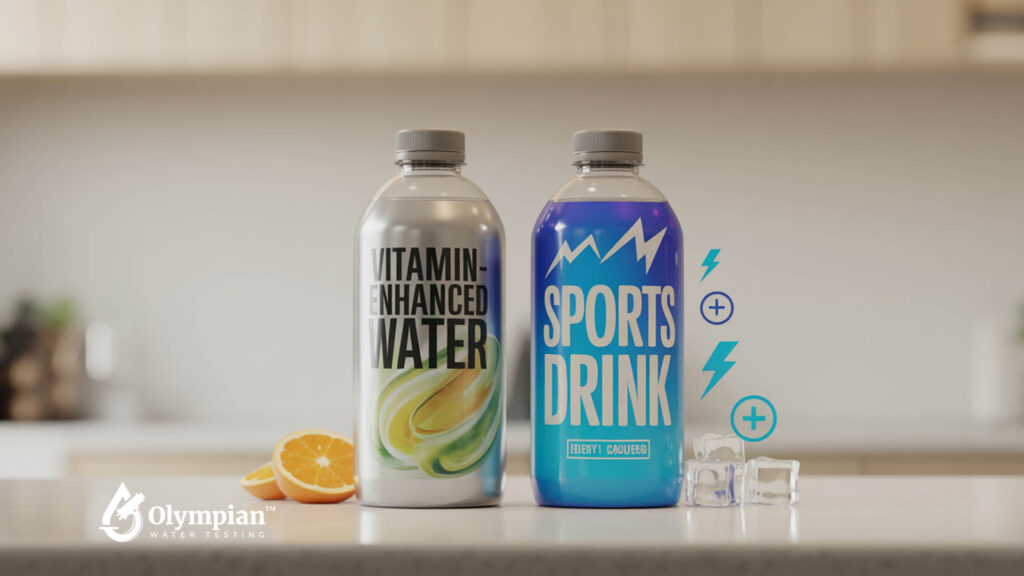
Vitamin-Enhanced Water and Sports Drinks
Vitamin water and sports drinks also have calories because of added sugars and other ingredients. Sports drinks are made to replace lost electrolytes and energy. This means they can have more calories than regular water. It’s important to think about these calories when picking a drink to stay hydrated.
The Role of Water in Metabolism and Weight Loss
Water is key to our health, especially in metabolism and weight loss. It helps our body turn food into energy. Not drinking enough can slow down our metabolism, leading to weight gain. Drinking water can boost our metabolism and help us lose weight.
Research shows that drinking more water can help break down fat and aid in weight loss. For example, a 2019 study found that many people drink lots of water to lose weight. Also, a 2023 study showed that drinking warm water after meals can lower BMI compared to others.
Some important findings on water and weight loss are:
- A 2018 study found that drinking water before meals can reduce hunger in people with average BMI.
- A 2019 review found that drinking more water can lead to weight loss of 0.4 to 8.8 kg, averaging 5% weight loss.
- Experts recommend drinking about 2 liters of water each day.
Understanding water’s role in metabolism and weight loss helps us make better hydration choices. As experts, we stress the importance of staying hydrated. We offer tips on how to drink more water for better health.
Conclusion: Understanding Water's True Value in Your Diet
Water is key to our diets, offering many benefits beyond just thirst relief. It has no calories but is crucial for our health. By learning about water, how it works in our bodies, and the importance of water testing, we can better choose how much to drink.
Drinking enough water helps our bodies work right, boosts metabolism, and aids in weight control. It can also help with headaches, constipation, and hangovers. As we learn more about water, we can make better choices for our health and well-being.
Share this on social media: