Microplastics in the 21st Century
Prepared by:
R & D Department of Olympian Water Testing™
Fact Checked by
Dr. Yasir A. Rehman PhD
Executive Summary
The presence of microplastics in drinking water has emerged as a serious challenge of the 21st century that needs immediate and sustained action. This white paper is dedicated to unveil the issue of microplastic contamination, despite its small size, it has serious effects over global water resources and human health.
The purpose of this document is also to explore the origins, pathways, and detrimental effects of microplastics in drinking water. It aims to shed light on these particles, their interaction with water sources, and the potential risks they cause to ecosystems and human beings.
The paper will provide a thorough analysis of current technologies for detecting and quantifying microplastics, alongside a review of the effectiveness of existing removal techniques.
Moreover, this white paper serves as public awareness for the need for such measures is critical, not only for the immediate protection of public health but also for the long-term viability of aquatic ecosystems.
Introduction
Microplastics are extremely small pieces of plastic debris, typically less than five millimeters across, that have become a major concern for environmentalists and scientists alike. These tiny particles come from larger pieces of plastic breaking down over time and from everyday products like exfoliating face washes, toothpastes, and synthetic fabrics that shed these particles. As a modern environmental challenge, microplastics are particularly troubling because they don’t break down easily. The microplastics are found almost everywhere, from the peaks of mountains to the depths of the oceans, and now, increasingly, in the water we drink. Studies show that these tiny particles have made their way into drinking water systems across the globe, which could potentially affect human health and the environment.
Each year, the average American ingests more than 70,000 microplastics in their drinking water supply.(2)
Regionally, the situation varies, but the problem remains serious. In North America, both the US and Canada have found microplastics not only in oceans and lakes but also in the tap water of urban and rural areas. In Europe, microplastics have been detected everywhere from urban water systems to the remote ice fields of the Arctic, showing that no area is untouched by this pollution.
The United States exhibited the highest contamination rate, reaching 94%, as plastic fibers were detected in tap water samples taken from various locations such as Congress buildings, the U.S. Environmental Protection Agency‘s headquarters, and Trump Tower in New York. Following closely were Lebanon and India with the next highest rates.
European countries, including the United Kingdom, Germany, and France, reported the lowest contamination rate at 72%. However, even with this lower rate, the average number of fibers discovered in each 500ml sample varied from 4.8 in the U.S. to 1.9 in Europe. (3)
of tap water in usa contain microplastics
Contamination rate in Germany and France
fiber/500ml in Usa
Microplastic containment challenge
Microplastics becomes a significant and complex challenge , usually originate from two main sources: primary and secondary microplastics. Primary microplastics are manufactured to be tiny for use in products like cosmetics and industrial abrasives, while secondary microplastics result from the breakdown of larger plastic items, such as water bottles and plastic bags, due to factors like sunlight exposure and physical wear.
Sources and Classifications of Microplastics
Microplastics come in various forms, shapes, and chemical compositions, which can affect how they interact with the environment and living organisms. Common classifications include:
Fibers from synthetic textiles like polyester and nylon, often released during laundry.
Microbeads found in personal care products such as face scrubs and toothpaste.
Fragments resulting from the degradation of larger plastic items.
Foams from materials like polystyrene used in food packaging and insulation.
Films from plastic bags and wrappers that disintegrate into smaller pieces.
Each type of microplastic has unique properties and sources, contributing differently to environmental pollution. (4)
| Type of Microplastic | Primary Sources | Secondary Sources |
| Fibers | Textiles, fishing nets | Wear and tear from clothes, carpets |
| Microbeads | Cosmetics (e.g., face scrubs, toothpaste) | Not applicable (directly released as microplastics) |
| Fragments | Industrial pre-production plastic pellets | Breakdown of plastic items like containers, toys |
| Foams | Insulation materials, packaging foams | Degradation of foam products in the environment |
| Films | Agricultural film | Disintegration of plastic bags and wrappers |
Most frequently observed polymer types across studies and records are PE ≈ PP > PS > PVC > PET, with Acrylic or acrylic-related compounds, PA, PEST and PMMA reported in five or more records. (5)
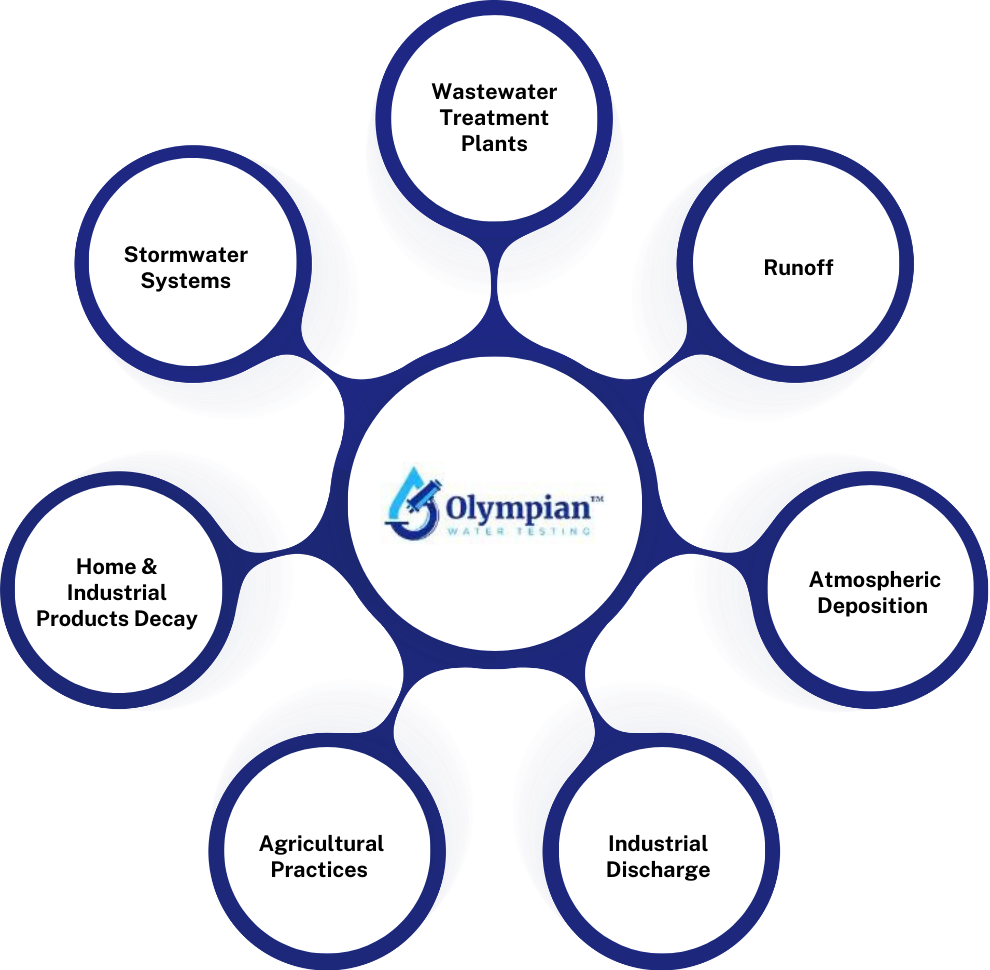
Sources of microplastic in drinking water
Pathways into Drinking Water Systems

Wastewater Treatment Plants:
Wastewater treatment plants aim to purify sewage and industrial waste before releasing it into rivers or recycling. However, many plants lack the technology to filter out microplastics, leading to their release into aquatic environments and potentially contaminating drinking water. (7)
Runoff:
Runoff occurs when rainwater or melted snow flows over the ground, picking up debris, chemicals, and pollutants, including microplastics. This can happen in urban areas, where microplastics accumulate on streets and sidewalks from various sources like tire wear, synthetic textiles, and litter. In rural areas, runoff might carry microplastics from agricultural activities or litter. The runoff eventually drains into local streams, rivers, lakes, or reservoirs — many of which serve as sources for public water systems. (7)
Atmospheric Deposition:
Microplastics, including lightweight fibers, can be transported through the air by wind and traffic. This process, called atmospheric deposition, allows microplastics to travel long distances before settling on land or water surfaces, contributing to contamination even in remote lakes and reservoirs.(8)

Industrial Discharge:
Industries producing or utilizing large amounts of plastic can contribute to microplastic pollution in water bodies through inadequate containment measures. Regulations and technology are essential to prevent this and safeguard water quality.(7)

Agricultural Practices:
Agricultural activities contribute significantly to the dispersal of microplastics into the environment, which can then infiltrate water systems. Microplastics are present in various agricultural inputs such as plastic mulches, films, and slow-release fertilizers. Furthermore, the mechanical action of tilling and harvesting can break down larger plastic residues into microplastics. These particles can be washed into nearby waterways through irrigation runoff or rain, introducing microplastics into sources that may eventually feed into drinking water supplies. (7)

Sources of microplastic in drinking water

Home and Industrial Products Decay:
Plastic products degrade over time, releasing microfibers into the environment from items like carpets, clothing, and industrial products. Microplastics can enter water sources through wastewater if not removed by treatment facilities. (8)

Stormwater Systems:
Stormwater systems, designed to manage surface water runoff in urban and suburban areas, often carry unchecked runoff directly to rivers, lakes, and oceans without any treatment. This water can collect microplastics from roads, roofs, and other surfaces and transport them directly into the environment. Given that these systems are designed to prevent flooding rather than filter pollutants, they are a significant amount of microplastics to enter natural water bodies, which may be linked to municipal drinking water sources. (8)
Detection & Removal Technologies
The detection and removal of microplastics from drinking water are crucial steps toward safeguarding public health and preserving the integrity of global water supplies. This section provides an overview of the current technologies and methods used for these purposes, as well as a detailed presentation of the innovative approaches adopted by Olympian Water Testing.
Current Technologies and Methods of detection:

Fourier-Transform Infrared Spectroscopy (FTIR):
This technique is widely used for identifying the chemical composition of microplastics by measuring the infrared intensity versus wavelength. FTIR can identify different types of polymers in microplastics and is effective for particles larger than 20 microns. (12)

Raman Spectroscopy:
Similar to FTIR, Raman spectroscopy uses light scattering to provide detailed information about the molecular structure of microplastics. It is particularly useful for analyzing smaller microplastics (down to 1 micron) and can differentiate between polymer types. (13)

Pyrolysis Gas Chromatography Mass Spectrometry (Py-GC/MS):
This method involves decomposing microplastics at high temperatures and then analyzing the resulting gases to identify the polymers. It is highly accurate and can process very small samples effectively.
Detection & Removal Technologies
Current Technologies and Methods of removal:

Filtration Systems:
Advanced filtration technologies such as membrane filtration and nano-filtration are capable of removing microplastics from water. These systems use physical barriers to separate microplastics based on size exclusion. (9)

Adsorption:
Using materials like activated carbon, biochar, or other adsorbents, this method can effectively trap microplastics on the surface of the adsorbent material, removing them from the water. (10)

Dissolved Air Flotation (DAF):
This technique is used primarily for the removal of larger microplastics. It works by dissolving air in the water under pressure and then releasing it at atmospheric pressure, which forms bubbles that attach to microplastic particles and float them to the surface for removal. (11)
Recent Scientific Studies on
Microplastics in Drinking Water
Recent scientific investigations have substantially contributed to our understanding of microplastics in drinking water and their potential impacts on human health. These studies have examined various aspects, from the prevalence and distribution of microplastics in water supplies to their biological effects on human cells. Here is an overview of some key findings from the latest research:
A landmark study conducted by researchers from the University of Newcastle, Australia, in collaboration with the World Wide Fund for Nature (WWF), reported that the average person could be ingesting approximately 2,000 tiny particles of plastic each week, equivalent to 5 grams of plastic, with the largest contribution coming from drinking water. This study highlighted not only the ubiquitous nature of microplastics in global water systems but also the substantial degree to which they enter the human diet. (14)
In-depth studies have investigated the mechanisms through which microplastics infiltrate water systems. Research published in the Journal of Water and Health detailed how microplastics from household and industrial waste accumulate in municipal wastewater and often bypass treatment processes due to their small size. These findings are crucial as they underline the limitations of current water treatment technologies in filtering out microplastics.
Research focusing on the health impacts of microplastics has been studied. A pivotal study by the State University of New York at Fredonia and the University of Minnesota analyzed the presence of microplastics in major bottled water brands. The study found that 93% of the sampled bottled water contained microplastics, suggesting that bottled water, not just tap water, could be a significant source of plastic ingestion. The implications of these findings are profound as they challenge the perception of bottled water as being a cleaner alternative to tap water. (15)
To understand the biological impact of microplastics, scientists have conducted toxicological assessments. A study from the University of Eastern Finland explored the cytotoxic effects of microplastics on human lung cells. The researchers found that exposure to microplastics led to markers of oxidative stress and inflammation, suggesting potential harm to human tissues upon exposure.
Due to evidence of microplastics in drinking water, regulatory bodies are taking it serious. The European Food Safety Authority (EFSA) and the U.S. Environmental Protection Agency (EPA) have initiated reviews of microplastic pollution, aiming to assess risk levels and explore the need for regulatory measures. This is in line with calls from the scientific community for urgent research into the long-term impacts of chronic exposure to microplastics. (16) (17)
Case Studies and Practical Examples
To effectively illustrate the impact of microplastics and the potential solutions to mitigate their presence, several case studies and practical examples from around the world have been selected. These examples not only demonstrate the severity of microplastic pollution but also highlight innovative approaches and successful interventions that have been implemented to tackle this issue.
Case Study 1: Microplastic Contamination in the Great Lakes, USA (18)
Background: The Great Lakes are a one of most important water resource, providing drinking water to over 40 million people. Recent studies have highlighted significant microplastic contamination in these waters.
Findings: Research conducted by the State University of New York and the Great Lakes Institute found high levels of microfibers and microbeads in all five lakes, with the highest concentrations near urban centers.
Intervention: The decision taken by environmental groups led to the Microbead-Free Waters Act of 2015, which banned the manufacture of cosmetic products containing microbeads. Subsequent water quality assessments have shown a decrease in microbead concentrations in the lakes.
Case Study 2: Microplastics Reduction in Wastewater Treatment Facilities, Netherlands (19)
Background: Wastewater treatment plants are recognized as significant sources of microplastic release into aquatic environments.
Findings: A Dutch study found that secondary and tertiary treatment processes could still allow microplastics to pass through due to their small size.
Intervention: The installation of advanced filtration systems using membrane bioreactors has been piloted in several Dutch wastewater treatment facilities. These systems have been effective in removing up to 99.9% of microplastics from treated water.
Case Study 3: Community-Led Beach Clean-Ups, Australia (20)
Background: Coastal regions are particularly vulnerable to microplastic pollution, affecting marine life and beach quality.
Findings: Microplastics were prevalent on many popular beaches, originating from both local sources and ocean currents.
Intervention: Local communities organized regular beach clean-ups, which not only helped reduce the amount of visible plastic waste but also raised public awareness about the sources and effects of microplastic pollution. Educational campaigns accompanying these clean-ups have led to increased community engagement and changes in local waste management practices.
Role of Water Testing Companies
Water testing companies play a pivotal role in managing environmental pollutants, particularly microplastics, which pose a significant threat to water quality and public health. Their expertise and technologies are crucial in detecting, analyzing, and guiding the mitigation of these contaminants in water systems.
Critical Role of Professional Testing Services:
Professional water testing services are essential for accurately assessing the presence and concentration of microplastics in various water bodies. These companies employ advanced analytical techniques, such as Raman spectroscopy, FTIR (Fourier-transform infrared spectroscopy), and GC-MS (gas chromatography-mass spectrometry), which enable the precise identification and quantification of microplastic particles. Through rigorous testing protocols, these services provide essential data that inform both public health advisories and environmental policies.
Furthermore, water testing companies contribute to research and development in the field of microplastic detection. By continually advancing their methodologies and equipment, they help to push the boundaries of what is currently known about microplastic pollution. This ongoing research is vital for keeping pace with the evolving nature of microplastic materials and their ever-changing sources and applications.
Olympian Water Testing as
an Industry Leader
Olympian Water Testing has positioned itself as a leader in ensuring water quality and safety by adopting a proactive approach to microplastic pollution. Recognizing the growing concern over these contaminants, Olympian Water Testing has invested in state-of-the-art technology and professional expertise to specialize in the detection and analysis of microplastics in drinking water, industrial effluents, and natural water bodies.
The company’s approach involves not just testing but also participating in educational and community engagement initiatives. By working with local communities, governments, and international bodies, We help to raise awareness about the sources of microplastic pollution and the importance of effective water management strategies.
Moreover, Olympian Water Testing is committed to transparency and reliability in its testing results, providing clear and accessible reports that help water managers, policymakers, and the general public make informed decisions about water use and treatment strategies. Their contributions are not only technical but also informative, making a significant impact on public health and environmental conservation efforts.
Through collaborations with environmental scientists and regulatory agencies, Olympian Water Testing contributes to the development of new regulations and standards aimed at reducing microplastic pollution. Their active participation in shaping industry best practices demonstrates their commitment to leading the charge in safeguarding water quality for future generations.
Conclusion
The presence of microplastics in our water systems is a pervasive challenge that spans global and local scales, affecting ecosystems, wildlife, and human populations. Microplastics, due to their small size and widespread use, have infiltrated water systems worldwide. Their presence in both tap and bottled water illustrates a critical environmental issue that demands immediate attention.
While the immediate health risks of microplastics are currently considered low, the potential for long-term effects remains a significant concern, necessitating ongoing research and rigorous scientific investigation.
Advances in technology like ultra filtration and other mentioned have enabled more precise detection of microplastics, yet significant challenges remain in effectively removing these particles from water. Innovations in water treatment and filtration are essential to cope with the complexities posed by microplastic pollution.
Companies like Olympian Water Testing play a crucial role in addressing microplastic pollution. Through advanced testing, research, and collaboration, these entities provide vital insights and solutions that support public health and environmental sustainability.
Moreover, public education and awareness play a pivotal role. Informing individuals about the sources and impacts of microplastics can drive behavioral changes that are necessary for reducing pollution at the source. This collective action is vital for ensuring the health of our water bodies and, by extension, the health of all species that depend on them, including ourselves.
Eradicating microplastic contamination in drinking water is not just an environmental or technical challenge—it is a global challenge that requires a holistic approach and unwavering commitment from all sectors of society. By maintaining a proactive stance and pushing the boundaries of scientific and technological innovation, we can safeguard our water resources for future generations.
References
1-:https://wwf.panda.org/wwf_news/?348337/Revealed-plastic-ingestion-by-people-could-be-equating-to-a-credit-card-a-week
2-:https://www.sciencedaily.com/releases/2019/06/190605100332.htm
3-:https://www.theguardian.com/environment/2017/sep/06/plastic-fibres-found-tap-water-around-worldstudyreveals#:~:text=The%20US%20had%20the%20highest,had%20the%20next%20highest%20rates.
4-:https://www.ncbi.nlm.nih.gov/pmc/articles/PMC6449537/
5-: https://www.newcastle.edu.au/newsroom/featured/plastic-ingestion-by-people-could-be-equating-to-a-credit-card-a-week
6-:https://pubs.acs.org/doi/10.1021/acssuschemeng.2c02896
7-:https://www.researchgate.net/publication/313036520_Microplastics_en_route_Field_measurements_in_the_Dutch_river_delta_and_Amsterdam_canals_wastewater_treatment_plants_North_Sea_sediments_and_biota
8-: https://knowledge.aidr.org.au/media/7351/case-studies-exploring-community-led-recovery-and-coordination-final.pdf
9-:https://www.researchgate.net/publication/351049429_The_pathways_of_microplastics_contamination_in_raw_and_drinking_water
10-: https://www.mdpi.com/2073-4441/16/9/1228
11-: https://www.ncbi.nlm.nih.gov/pmc/articles/PMC10877293/
12-: https://www.mdpi.com/2673-4672/4/2/15
13-: https://www.sciencedirect.com/science/article/pii/S2666498422000783
14-: https://pubs.rsc.org/en/content/articlehtml/2023/va/d2va
15-:www.researchgate.net/publication/279457192_Identification_of_microplastics_by_FTIR_and_Raman_microscopy_a_novel_silicon_filter_substrate_opens_the_important_spectral_range_below_1300_cm-1_for_FTIR_transmission_measurements
16-:https://www.efsa.europa.eu/en/news/microplastics-and-nanoplastics-food-emerging-issue
17-:https://www.epa.gov/water-research/microplastics-research
18-:https://pubs.acs.org/doi/10.1021/acssuschemeng.2c02896
19-:https://www.researchgate.net/publication/313036520_Microplastics_en_route_Field_measurements_in_the_Dutch_river_delta_and_Amsterdam_canals_wastewater_treatment_plants_North_Sea_sediments_and_biota
20-:https://knowledge.aidr.org.au/media/7351/case-studies-exploring-community-led-recovery-and-coordination-final.pdf