

10 Tips for Effective Uranium Testing in Drinking Water

A technical paper by Olympian Water Testing specialists

Introduction to uranium and its environmental impacts
Uranium is a radioactive metal that occurs in the earth’s crust in trace quantities. It is mostly present as uranium ore, which can be mined and processed into fuel for nuclear power plants [1].
Uranium exists naturally in soil, rock and water. It is usually abundant in nature, but can be emitted to the atmosphere, oceans and land by human-caused processes such as extraction and fossil fuel combustion [2].
There are environmental and health effects from exposure to uranium. In the wild, uranium accumulates in plants and animals that may impact wildlife and environment [3]. The consumption of high doses of uranium in humans has kidney injury, anemia and other detrimental health effects [4].
You should test for uranium in drinking water to keep it below acceptable levels. The WHO has given a guideline level for uranium in water that is 30 g/L, due to potential for health effects of long-term exposure [5]. The US Environmental Protection Agency (EPA) has set a 20 g/L MCL for uranium in drinking water, using the same health criteria [6].
The bottom line is that uranium is a naturally occurring radioactive metal found in trace quantities in the Earth’s crust. It can be harmful to the environment and to human health, and uranium should be checked and tested in drinking water to keep it within permissible levels.
[1] International Atomic Energy Agency. (n.d.). Uranium.
[2] United States Geological Survey. (2019, September 12). Uranium.
[3] United Nations Environment Programme. (n.d.). Uranium.
[4] World Health Organization. (2011). Uranium in Drinking-water.
[5] World Health Organization. (2011). Guidelines for Drinking-water Quality.
[6] Environmental Protection Agency. (n.d.). Uranium. Retrieved from https://www.epa.gov
History of uranium in drinking water

Uranium is also a known presence in drinking water as a natural element in water supplies and human created byproducts.
Uranium is in the water from the dawn of the planet, and it naturally occurs in traces in soil, rock and water [1]. It’s usually abundant at very low levels in the environment, but can be introduced into the air, water and soil by human actions like mining and fossil fuel burning [2].
The burning of uranium as fuel in nuclear reactors has led to uranium ending up in the drinking water too. Nuclear power stations burn uranium for fuel, and the process of electricity generation spills tiny doses of uranium into the atmosphere [3]. Furthermore, nuclear waste storage and destruction can be another cause of uranium being found in the environment [4].
Uranium in water is a problem that has been debated for years, and regulations and guidelines have been developed to solve it. The Environmental Protection Agency (EPA) in the United States has set a MCL for uranium in water that is 20 g/L based on the risk of long-term health effects [5]. Also, uranium in drinking water was set as a guideline value at 30 g/L by the WHO, on the same health grounds [6].
Final Thoughts: Uranium has a long history in water as a natural component and a human-caused resource. Numerous regulations and guidelines were introduced to solve the problem of uranium in water and safeguard the public.
[1] International Atomic Energy Agency. (n.d.). Uranium.
[2] United States Geological Survey. (2019, September 12). Uranium.
[3] United States Nuclear Regulatory Commission. (n.d.). How Nuclear Power Plants Work.
[4] World Nuclear Association. (n.d.). Nuclear Waste Management.
[5] Environmental Protection Agency. (n.d.). Maximum Contaminant Levels for Uranium.
[6] World Health Organization. (2017). Guidelines for Drinking-water Quality. Retrieved from https://www.who.int/
Methods for testing for uranium in drinking water

It is possible to test drinking water for uranium in a number of different ways: laboratory and field.
The most common laboratory testing for uranium in drinking water is ICP-MS [1]. This is by dissolving the water sample and then ionising the uranium atoms with a high-energy plasma. The ions are then separated by mass-to-charge ratio and observed in a mass spectrometer to calculate the uranium levels with pinpoint accuracy.
A second lab-based test for uranium in drinking water is atomic absorption spectroscopy (AAS) [2]. It is done by dissolving the water sample and measuring how light is absorbed by the suspended uranium atoms. Light absorbs inversely with the amount of uranium in the sample and so uranium concentrations can be determined.
There are also some field-based tests that can be conducted for uranium in water. Field-portable X-ray fluorescence (XRF) instruments are one such example [3]. These devices fire X-rays to excited the atoms in the sample and the fluorescence is read out to detect levels of various elements such as uranium.
The other field test for uranium in drinking water is through strips or kits [4]. Such kits often use chemical reactions to detect uranium in the water sample and are field-ready for quick results.
In sum, the uranium in drinking water testing methods that can be applied in both lab and field environments are several. These are inductively coupled plasma mass spectrometry, atomic absorption spectroscopy, field-portable X-ray fluorescence equipment, and test strips or kits.
[1] United States Geological Survey. (n.d.). Inductively coupled plasma mass spectrometry.
[2] International Atomic Energy Agency. (n.d.). Atomic absorption spectrometry.
[3] United States Geological Survey. (n.d.). Field-portable X-ray fluorescence.
[4] United States Environmental Protection Agency. (n.d.). Test kits and strips for drinking water.
Factors that can affect the accuracy of uranium testing

Correct uranium testing in water can keep levels below safe limits and keep the public healthy. But many things can contaminate the results of uranium testing: sample preparation, sample storage, instrument calibration.
You must prepare samples correctly in order to test for uranium. That means placing the water sample in a clean container and adhering to any special handling or storage recommendations given by the laboratory [1]. When you prepare the sample incorrectly, it can get contaminated or damaged and your test will be false.
Safely store samples too to make sure uranium testing is correct. Samples of water must be maintained at the required temperature and kept in a clean bottle, so that they are not contaminated or lost [2]. There is also a need to keep the sample in the sample as little as possible from sample acquisition to analysis for its integrity.
The instrument calibration is also something that can influence uranium testing. To calibrate the instrument and be sure that the uranium concentration being measured by the instrument is right and the calibration must be done on regular basis to ensure the accuracy of test results [3]. Calibration is where standard reference materials are used to ensure that the instrument is calibrated correctly and should be adjusted if required to make sure that the instrument is working properly.
Conclusion Sample preparation, storage and instrument calibration are key considerations for accuracy of uranium in drinking water testing. Getting those factors covered in a way can ensure that test results are valid and accurate.
[1] United States Environmental Protection Agency. (2017, June). Drinking water sampling and analysis: Tips for laboratory professionals.
[2] World Health Organization. (2017). Water sampling and analysis.
[3] National Renewable Energy Laboratory. (n.d.). Calibration and traceability in measurement.
Best practices for collecting and storing water samples

To test for uranium in drinking water, water samples must be taken and stored correctly. There are several best practices that need to be followed so water samples can be representative of the source and non-contaminated.
For water samples a good rule of thumb is using clean and well labeled container [1]. Containers should be washed with the water being sampled so that the container does not become contaminated. Remember to follow any specific sample collection and processing procedure set by the laboratory [2].
You need to store the water samples in a suitable temperature and in a clean container to avoid contamination while storing the samples [3]. Water samples should be kept at room temperature in a dark place to avoid degrading and the bottles must be sealed so no contaminants can enter. Furthermore, sample collection to analysis interval should be as short as possible to maintain sample integrity [4].
Conclusion : Water samples should be collected and stored appropriately for proper uranium analysis of water. For best practices in water sample collection and storage, the appropriate sample containers should be clean and clearly marked, samples must be collected according to defined sample collection and handling procedures, they must be stored at the correct temperature and in a clean container, and samples should be held for as short as possible between collection and analysis.
[1] World Health Organization. (2017). Water sampling and analysis.
[2] United States Environmental Protection Agency. (2017, June). Drinking water sampling and analysis: Tips for laboratory professionals.
[3] United States Geological Survey. (n.d.). Sample collection and preparation.
[4] United States Geological Survey. (n.d.). Sample preservation, storage, and transport.
Quality control measures for uranium testing

Quality control is an important aspect of uranium testing to ensure the accuracy and reliability of test results. There are several quality control measures that can be implemented to improve the quality of uranium testing, including the use of standards and quality assurance/quality control (QA/QC) protocols.
Standards are important in uranium testing as they provide a reference point for measuring the accuracy of test results. Standards can be used to calibrate instruments and check the performance of the testing process [1]. There are several types of standards that can be used in uranium testing, including reference materials, certified reference materials, and standard solutions.
Quality assurance/quality control (QA/QC) protocols are also important in uranium testing to ensure the accuracy and reliability of test results. QA/QC protocols involve the implementation of procedures and processes to ensure the quality of the testing process [2]. These protocols may include the use of standards, the implementation of standard operating procedures (SOPs), and the regular checking and maintenance of equipment.
In conclusion, quality control is an important aspect of uranium testing to ensure the accuracy and reliability of test results. The use of standards and QA/QC protocols are effective measures to improve the quality of uranium testing.
[1] United States Environmental Protection Agency. (2017, June). Drinking water sampling and analysis: Tips for laboratory professionals.
[2] World Health Organization. (2017). Water sampling and analysis. Retrieved from https://www.who.int/
Regulations and guidelines for uranium in drinking water

Uranium is a naturally occurring radioactive metal that can be found in trace amounts in drinking water. The presence of uranium in drinking water can have negative impacts on human health, and it is important to ensure that levels are within safe limits. To help protect public health, various regulations and guidelines have been put in place for uranium in drinking water.
In the United States, the Environmental Protection Agency (EPA) has established a maximum contaminant level (MCL) for uranium in drinking water of 20 μg/L [1]. This MCL is based on the potential for adverse health effects from long-term exposure to uranium, and it is enforceable by law. The EPA also has a maximum contaminant level goal (MCLG) for uranium in drinking water of 0 μg/L, which is the level at which no adverse health effects are expected to occur [2].
The World Health Organization (WHO) has also established guidelines for uranium in drinking water. The WHO has a guideline value of 30 μg/L for uranium in drinking water, based on the potential for adverse health effects from long-term exposure [3]. This guideline value is not legally binding, but it is used as a reference point for national regulations and as a basis for the development of risk management strategies.
In addition to the MCL and guideline value, there are also action levels for uranium in drinking water that may be used to trigger additional monitoring or treatment of water sources. For example, the EPA has a secondary maximum contaminant level (SMCL) for uranium in drinking water of 30 μg/L [4]. This SMCL is not enforceable by law, but it is used as a reference point for monitoring the aesthetic quality of drinking water, such as taste and odor.
In conclusion, various regulations and guidelines have been put in place for uranium in drinking water to help protect public health. These regulations and guidelines include the EPA’s MCL and MCLG, the WHO’s guideline value, and the EPA’s SMCL. It is important to ensure that levels of uranium in drinking water are within these limits to minimize the potential for adverse health effects.
[1] United States Environmental Protection Agency. (2019, June 26). Drinking water regulations and guidance.
[2] United States Environmental Protection Agency. (2019, June 26). Maximum contaminant level goal (MCLG).
[3] World Health Organization. (2017). Guidelines for drinking-water quality.
[4] United States Environmental Protection Agency. (2019, June 26). Secondary maximum contaminant level (SMCL).
Health effects of uranium in drinking water

Exposure to uranium in drinking water can have negative impacts on human health. The potential health effects of exposure to uranium depend on the level of exposure and the duration of exposure [1].
Chronic exposure to high levels of uranium in drinking water can lead to kidney damage [2]. This is because uranium is a toxic metal that can accumulate in the kidneys and cause inflammation and scarring [3]. In severe cases, chronic kidney damage can lead to kidney failure [4].
In addition to kidney damage, chronic exposure to high levels of uranium in drinking water can also lead to other adverse health effects, such as anemia [5]. Anemia is a condition in which the body does not have enough red blood cells, which can lead to symptoms such as fatigue and shortness of breath [6].
It is important to note that the risks and hazards associated with exposure to uranium in drinking water are largely unknown [7]. More research is needed to understand the full range of health effects of exposure to uranium and to identify any potential risks or hazards.
In conclusion, exposure to uranium in drinking water can lead to kidney damage and other adverse health effects. However, the full range of health effects of exposure to uranium and any potential risks or hazards are largely unknown and more research is needed to fully understand these impacts.
[1] World Health Organization. (2017). Water sampling and analysis.
[2] United States Environmental Protection Agency. (2017). Uranium in drinking water.
[3] International Atomic Energy Agency. (n.d.). Health effects of exposure to uranium.
[4] Mayo Clinic. (2019, June 14). Kidney failure.
[5] Centers for Disease Control and Prevention. (2020, May 21). Anemia.
[6] Mayo Clinic. (2019, November 6). Anemia.
[7] United States Environmental Protection Agency. (2017). Uranium in drinking water.
Strategies for reducing uranium levels in drinking water

There are several strategies that can be used to reduce the levels of uranium in drinking water, including the use of water treatment or filtration technologies.
One effective method for reducing uranium levels in drinking water is through the use of water treatment technologies, such as reverse osmosis or ion exchange [1]. Reverse osmosis is a process in which water is forced through a membrane, which removes contaminants, including uranium, from the water. Ion exchange involves the use of a resin to remove contaminants from the water, including uranium.
Another strategy for reducing uranium levels in drinking water is through the use of filtration technologies, such as activated carbon filters or sand filters [2]. Activated carbon filters work by adsorbing contaminants, including uranium, onto the surface of the carbon. Sand filters work by trapping contaminants, including uranium, in the pores of the sand.
In addition to these technologies, there are also several other strategies that can be used to reduce uranium levels in drinking water. These strategies include the use of alternative water sources, such as surface water or groundwater, that have lower levels of uranium, and the use of water treatment chemicals, such as lime or soda ash, to reduce the solubility of uranium in the water [3].
In conclusion, there are several strategies that can be used to reduce the levels of uranium in drinking water, including the use of water treatment technologies, filtration technologies, and alternative water sources. Implementing these strategies can help to ensure that levels of uranium in drinking water are within safe limits and protect public health.
[1] United States Environmental Protection Agency. (2017). Uranium in drinking water.
[2] World Health Organization. (2017). Water sampling and analysis.
[3] United States Geological Survey. (2019, September 12). Uranium. Retrieved from https://www.usgs.gov/
Conclusion and future directions
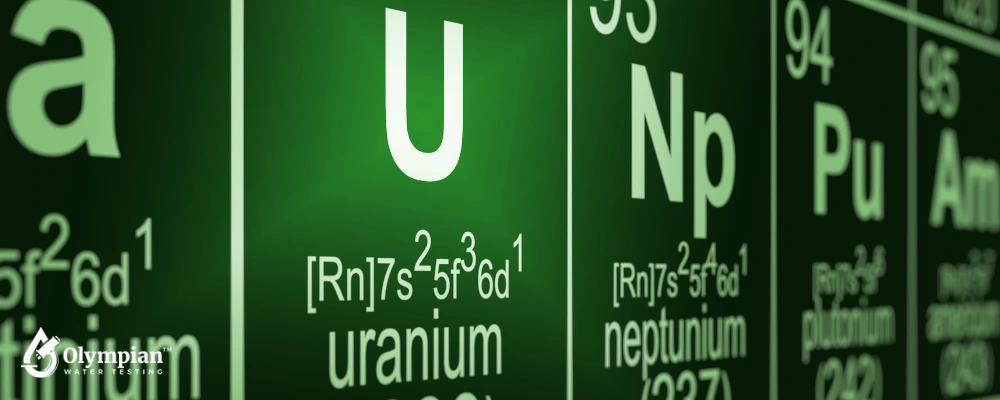
Uranium is a naturally occurring radioactive metal that can be found in trace amounts in drinking water. The presence of uranium in drinking water can have negative impacts on human health, and it is important to ensure that levels are within safe limits. To protect public health, various regulations and guidelines have been put in place for uranium in drinking water, and various methods are available for testing for uranium in drinking water. However, there are several factors that can affect the accuracy of uranium testing, including sample preparation, sample storage, and instrument calibration. Quality control measures, such as the use of standards and quality assurance/quality control protocols, are also important to ensure the accuracy and reliability of test results.
There are also various strategies that can be used to reduce the levels of uranium in drinking water, such as water treatment or filtration technologies. For example, reverse osmosis filtration can be used to remove uranium from drinking water [1]. In addition, certain water treatment processes, such as coagulation and flocculation, can also be effective at removing uranium from drinking water [2].
In conclusion, ensuring the accuracy and reliability of uranium testing in drinking water is important to protect public health. Further research is needed to better understand the health effects of exposure to uranium and to identify potential risks or hazards. Additionally, ongoing research is needed to develop and improve strategies for reducing the levels of uranium in drinking water, including the use of water treatment and filtration technologies.
[1] United States Environmental Protection Agency. (2017). Reverse osmosis filtration.
[2] World Health Organization. (2011). Guidance manual on drinking-water quality management for small community water supplies.
Share this research on social media
Facebook
Twitter
LinkedIn
See all Research on Uranium